
SEA MOTION develops high-performance linear drive motor solutions for industrial automation, precision machining, and high-speed positioning. By delivering direct linear motion without conventional mechanical transmission mechanisms, these motors help equipment manufacturers improve positioning accuracy, dynamic response, and production efficiency.
A linear drive motor converts electrical energy directly into straight-line motion, eliminating the need for intermediate transmission components such as ball screws, belts, and rack-and-pinion mechanisms. This direct-drive architecture reduces mechanical backlash and transmission-related wear while enabling high acceleration, repeatable positioning, and responsive motion control. From semiconductor manufacturing and laser cutting to electronics assembly and automated inspection, linear motors are increasingly valuable in applications that demand precision and throughput. This guide explains how linear drive motors work, compares common motor configurations, outlines their industrial applications, and identifies the essential factors engineers should evaluate when selecting a solution.
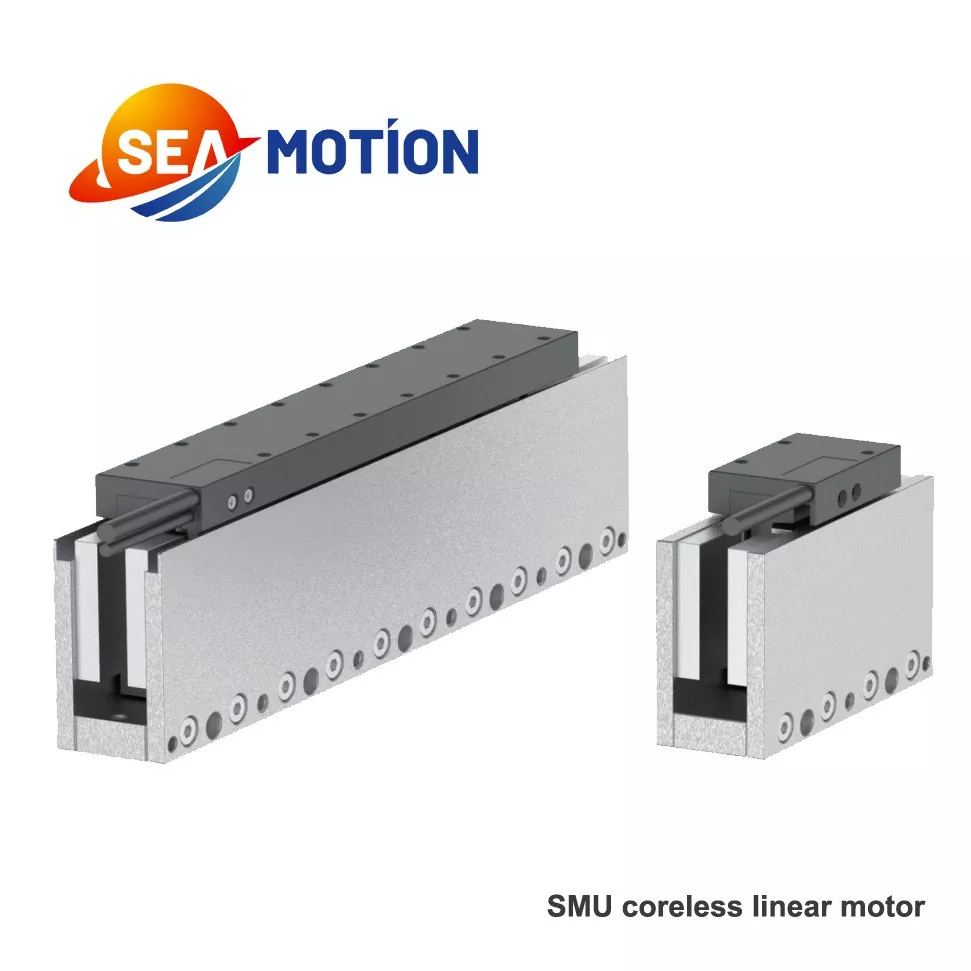
A linear drive motor is an electromagnetic actuator that produces linear thrust directly rather than generating rotary motion that must be converted into straight-line movement. It is commonly understood as an unwound rotary motor: its active electromagnetic components are arranged along a linear path, allowing a moving component to travel along a magnetic track.
In a typical permanent-magnet linear motor, the main components include:
Unlike a conventional rotary motor connected to a ball screw, a direct-drive linear motor does not require a rotary-to-linear transmission mechanism. This makes it particularly attractive for machines where mechanical clearance, transmission compliance, or speed limitations affect performance.
Explore the SEA MOTION linear drive motor product range to review available configurations and technical parameters.
The working principle of a linear drive motor is based on electromagnetic force. When a servo drive supplies controlled current to the motor windings, the resulting magnetic field interacts with the permanent magnets or corresponding magnetic structure to generate linear thrust.
The motion process generally follows four steps:
Because the motor generates linear motion directly, the system avoids transmission-related backlash and screw-pitch errors. However, overall positioning accuracy still depends on the encoder, servo tuning, guideway quality, thermal stability, mounting precision, and machine structure.
For applications requiring fast acceleration and frequent changes in direction, this direct-drive principle can improve dynamic response and reduce settling time when the motor and control system are correctly sized.
Direct drive eliminates backlash originating from conventional transmission mechanisms. When paired with an appropriate linear encoder, a rigid mechanical structure, and a well-tuned servo controller, a linear motor can support highly repeatable positioning for precision manufacturing.
Without the additional rotary-to-linear transmission stage, a linear motor can respond rapidly to commanded movements. This capability is useful for short-stroke positioning, high-frequency reciprocating motion, and production lines that require rapid movement between processing stations.
Linear motors do not require routine adjustment of ball-screw backlash or belt tension. They also eliminate wear in those transmission components. Linear guides, bearings, cooling systems, cables, and feedback devices may still require inspection and maintenance.
Direct thrust generation can reduce transmission-induced vibration and motion irregularities. In applications such as laser cutting, optical inspection, and precision dispensing, stable motion helps maintain consistent processing conditions.
Linear drive motors can be integrated into compact positioning stages, long-travel axes, gantry systems, and specialized automation equipment. Their suitability depends on the available installation space, required thrust, thermal design, and guide configuration.
Different motor structures offer different combinations of force density, attraction force, thermal behavior, and motion smoothness. SEA MOTION identifies several linear drive motor configurations for different equipment requirements.
| Motor Series | Structural Design | Key Selection Consideration | Potential Applications |
|---|---|---|---|
| SMJ | Flat magnetic, iron-core design | Evaluate thrust requirements, magnetic attraction, and structural stiffness | Industrial automation and precision machining |
| SMUC | Intermediate magnetic, iron-core design | Consider available mounting space, force requirements, and axis layout | Specialized positioning systems and automated equipment |
| SMU-H | Bilateral magnetic, iron-core design | Assess force output, magnetic balance, and mechanical integration | High-dynamic industrial motion systems |
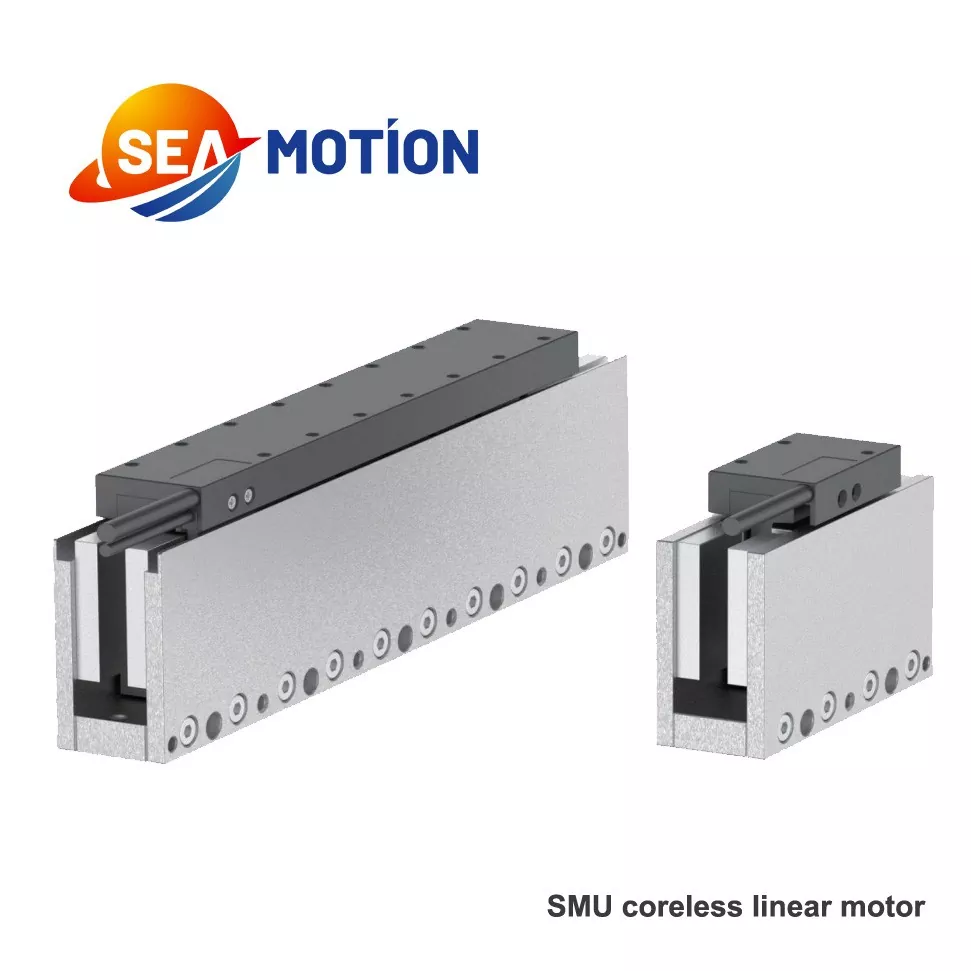
| SMU | Bilateral magnetic, ironless design | Consider low cogging, smooth motion, and thermal management | Precision positioning and sensitive inspection processes |
| SMJE / SMJD | Semi-closed / fully enclosed configurations | Check environmental protection, access, and installation requirements | Equipment requiring a more enclosed motor arrangement |
This table provides an initial selection framework rather than a universal performance ranking. Confirm the current model specifications, environmental requirements, and application suitability with the manufacturer before finalizing a design.
For detailed series information, visit the SEA MOTION linear motors page.
Wafer handling, precision inspection, die bonding, and display-panel processing require accurate movement and repeatable positioning. Linear motors can support these operations by providing fast, controlled travel and reducing transmission-related motion errors.
Laser processing equipment and high-precision machine tools often need fast movement, controlled acceleration, and accurate path tracking. Direct-drive linear axes can help improve throughput and reduce positioning errors associated with mechanical transmission systems.
Automated pick-and-place systems, dispensing machines, component assembly lines, and visual inspection equipment depend on consistent motion. Linear drive motors can support high-cycle operation and accurate movement between processing locations.
Battery manufacturing and solar-cell production involve repetitive positioning, alignment, stacking, and inspection. A properly engineered linear motor system can help maintain repeatability while meeting the acceleration and cycle-time requirements of automated production.
Imaging platforms, laboratory automation, and precision measurement equipment may benefit from smooth, controllable movement. Designers must also consider noise, vibration, temperature rise, cleanliness, and any application-specific safety requirements.
SEA MOTION also develops equipment based on linear drive motor technology, including high-precision laser cutting and visual recognition and inspection systems.
Choosing a suitable motor requires more than comparing maximum speed or peak thrust. Engineers should evaluate the entire motion axis, including the load, guideway, servo drive, feedback device, and thermal management system.
A useful starting point for acceleration force is:
Required acceleration force = Moving mass × Acceleration
For example, accelerating a 20 kg moving assembly at 10 m/s² requires 200 N of net acceleration force before accounting for friction, gravity, process forces, and other losses. The final motor selection must distinguish continuous thrust from peak thrust and verify that the complete axis can meet the required motion profile.
Review the manufacturer's linear drive motor specifications and request engineering support when the load or duty cycle is demanding.
| Evaluation Factor | Linear Drive Motor | Ball Screw or Belt Drive |
|---|---|---|
| Motion generation | Direct linear electromagnetic thrust | Rotary motion converted into linear travel |
| Transmission backlash | No mechanical transmission backlash | Depends on design, components, and adjustment |
| Dynamic response | Can support high acceleration and rapid response | Limited by transmission inertia, stiffness, and mechanical design |
| Mechanical wear | No ball-screw or belt transmission wear | Transmission components can wear over time |
| Thermal considerations | Coil heat dissipation and magnet temperature require evaluation | Motor, bearings, screw, and transmission heating require evaluation |
| Initial investment | Can be higher depending on the complete system design | Can be economical for conventional positioning tasks |
| Best-fit applications | High-speed, high-precision, demanding motion profiles | General-purpose positioning and cost-sensitive systems |
A linear drive motor is not automatically the best solution for every machine. Ball screws and belt drives remain practical for many applications, especially when moderate speed and accuracy satisfy the process requirements. The right choice depends on the performance target, system architecture, lifecycle cost, and operating environment.
Although direct-drive motors eliminate several mechanical transmission components, installation quality remains critical to long-term performance.
Before commissioning, test the motor across the intended speed, acceleration, load, and duty-cycle range. Record positioning performance and temperature under representative operating conditions. These checks help identify integration issues before full-scale production.
Its primary advantage is direct linear motion without a rotary-to-linear transmission mechanism. This eliminates transmission backlash and can enable high acceleration, precise positioning, and reduced maintenance associated with ball screws or belts.
Yes. Many linear drive motors are designed for rapid acceleration, high travel speeds, and frequent directional changes. Actual performance depends on motor thrust, moving mass, servo drive capability, encoder feedback, mechanical stiffness, and thermal limits.
Iron-core motors use an iron magnetic structure and can provide high force density, but magnetic attraction and cogging characteristics must be considered. Ironless motors eliminate the iron core in the moving coil assembly, which can reduce cogging and improve motion smoothness. The best choice depends on the application's thrust, precision, and thermal requirements.
The motor eliminates maintenance associated with conventional screw or belt transmission components. However, the complete system may still require inspection of linear guides, cables, encoders, cooling equipment, mounting hardware, and other components according to the operating environment and manufacturer recommendations.
Start by defining payload, travel distance, continuous and peak thrust, speed, acceleration, positioning accuracy, duty cycle, and installation conditions. Then verify electrical compatibility, cooling requirements, feedback options, and mechanical integration with the manufacturer.
SEA MOTION offers multiple linear motor configurations for precision motion applications. For a suitable recommendation, provide your required stroke, moving mass, target speed, acceleration, positioning accuracy, duty cycle, and installation constraints. The engineering team can use these details to help identify an appropriate configuration.
A linear drive motor can help manufacturers overcome the limitations of conventional transmission systems by delivering direct linear thrust, responsive motion control, and reduced transmission-related wear. Its advantages are especially relevant to semiconductor equipment, precision machining, laser processing, electronics assembly, and automated inspection. Successful implementation depends on selecting the correct motor structure, matching continuous and peak thrust to the real load, and integrating the motor with suitable guides, feedback, servo drives, and thermal management.
Whether you are upgrading an existing machine or developing a new automation platform, SEA MOTION can help you evaluate linear drive motor options for your application. Visit the official linear drive motor product page to review available configurations and technical parameters. If you need assistance with model selection, performance requirements, or a project-specific solution, contact us to discuss your requirements and request a tailored quotation.