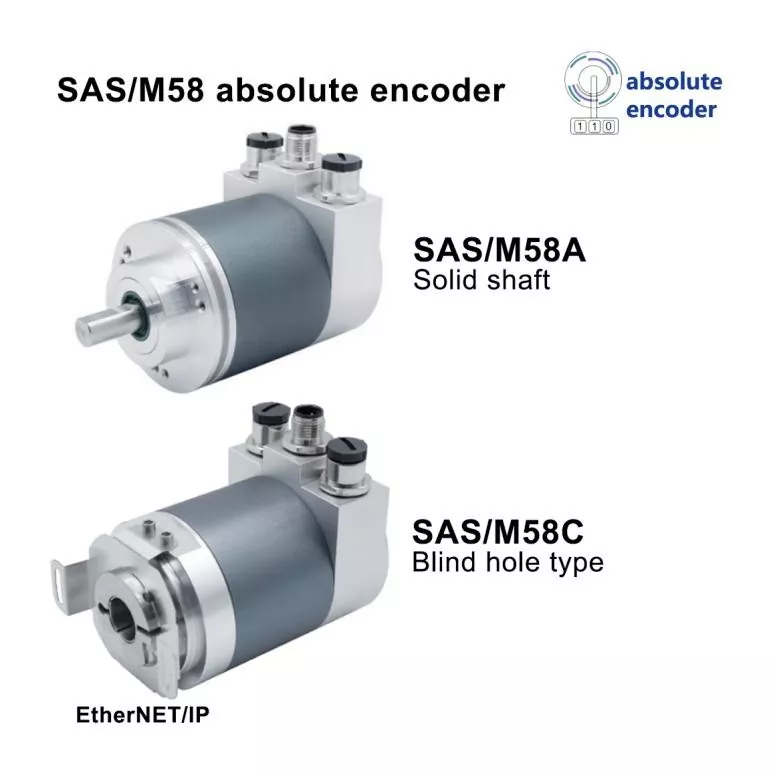

Jingyue develops precision motion-control components for demanding automation applications, and its Absolute Single Turn Photoelectric Encoder is designed for compact systems that require reliable angular position feedback. With miniature dimensions, 17-bit resolution, a hollow-shaft structure, RS485 communication, and speeds up to 20,000 RPM, this encoder is suitable for robotics, miniature motors, medical equipment, and precision automation.
An absolute single-turn photoelectric encoder is a precision rotary feedback device that determines the shaft position within one complete revolution. Unlike a conventional incremental encoder that relies on pulse counting, an absolute encoder provides a defined position value corresponding to the shaft angle. The photoelectric sensing principle uses optical detection to achieve high-resolution position measurement without physical contact between sensing components. For compact motion systems, the combination of 17-bit resolution, a miniature 8–26 mm outer diameter range, hollow-shaft construction, RS485 output, and a maximum allowable speed of 20,000 RPM makes this type of encoder suitable for applications where space, speed, and positioning performance must be balanced.
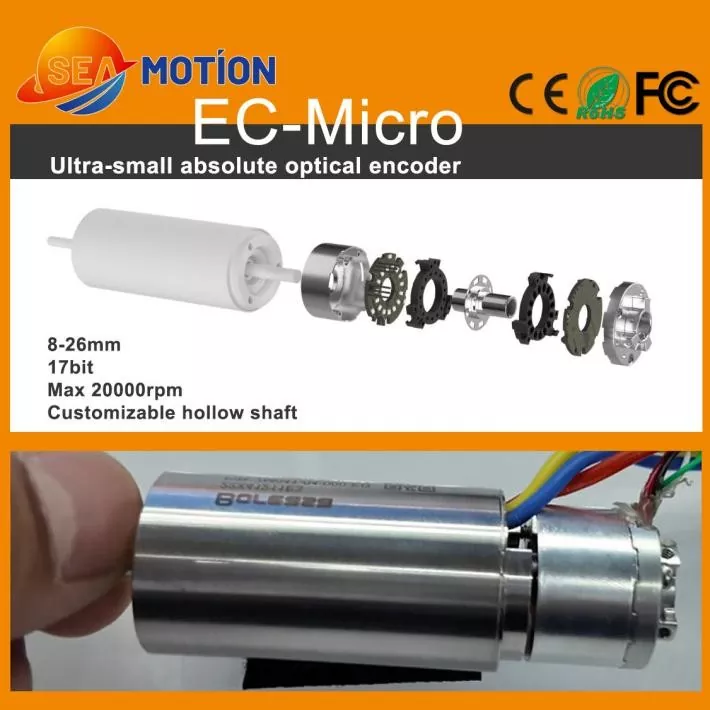
Table of Contents
- What Is an Absolute Single Turn Photoelectric Encoder?
- How Does a Photoelectric Encoder Work?
- What Are the Key Features?
- What Are the Main Technical Specifications?
- Where Is This Encoder Used?
- How Should Engineers Select the Right Encoder?
- What Should Be Considered During Installation?
- Frequently Asked Questions
- Conclusion
What Is an Absolute Single Turn Photoelectric Encoder?
An absolute single-turn photoelectric encoder is a rotary position sensor designed to determine the exact angular position of a rotating shaft within 360 degrees. Each angular position corresponds to a unique digital position value, allowing the control system to identify the shaft position directly.
The term "single turn" means that the encoder measures the angular position within one revolution rather than continuously tracking multiple revolutions. This makes it suitable for rotary mechanisms where precise single-turn positioning is the primary requirement.
"Photoelectric" describes the sensing technology. The encoder typically uses a light source, coded optical disc, and photoelectric detection components to convert shaft rotation into electrical signals. Because the sensing process is non-contact, optical technology can provide stable feedback while avoiding mechanical contact between the sensing elements.
The miniature construction is especially important for modern automation equipment. With available outer diameters from approximately 8 mm to 26 mm, a compact encoder can be integrated into small motors and mechanisms where installation space is limited.
For additional information about optical feedback technology, engineers can also explore photoelectric encoder solutions when comparing different rotary sensing technologies.
How Does a Photoelectric Encoder Work?
The operating principle of an absolute photoelectric encoder involves several coordinated processes:
- Shaft rotation: The encoder shaft rotates together with the motor or mechanical transmission system.
- Optical coding: A precision-coded disc rotates with the shaft and creates changing optical patterns.
- Light detection: Photoelectric sensors detect the optical changes generated by the rotating disc.
- Signal processing: Internal electronic circuits process the detected signals into position information.
- Digital output: The encoder transmits position data to the motion controller through the specified communication interface.
This process allows the controller to obtain an angular position value instead of relying only on accumulated movement pulses. As a result, absolute position feedback can be valuable in precision motion applications where the current shaft position needs to be identified accurately.
What Are the Key Features?
Miniature Size for Space-Constrained Equipment
Compact automation mechanisms often have very limited installation space. The encoder's 8–26 mm outer diameter range allows designers to integrate position feedback into miniature motors, robotic joints, medical instruments, and other densely arranged mechanisms.
17-Bit Resolution
The encoder provides 17-bit resolution, enabling the control system to distinguish fine changes in angular position. High resolution is particularly useful in applications involving precision positioning, delicate robotic movements, and compact servo mechanisms.
However, encoder resolution should not be confused with overall system accuracy. Mechanical tolerances, shaft alignment, vibration, controller performance, motor characteristics, and installation conditions can all influence the final positioning result.
High-Speed Capability
Miniature motors can operate at high rotational speeds, especially in compact actuators and precision equipment. The specified maximum allowable speed of up to 20,000 RPM makes the encoder suitable for selected high-speed applications when the complete motor and mechanical system are designed accordingly.
Hollow-Shaft Construction
A hollow-shaft design can simplify integration around miniature motor shafts. It can also help reduce the space required for mechanical coupling compared with certain conventional solid-shaft arrangements.
RS485 Digital Communication
The encoder uses an RS485 output interface and supports a specified baud rate of 2.5 Mbps. This provides a digital communication solution for transmitting position information between the encoder and compatible control electronics.
Optical Sensing
Photoelectric sensing provides a non-contact method of position detection. It can be particularly useful in applications where designers prefer optical feedback rather than magnetic sensing technology.
What Are the Main Technical Specifications?
Understanding the technical parameters is essential when integrating an encoder into a new machine. The following table summarizes the main specifications associated with the miniature encoder configuration.
| Technical Parameter | Specification | Why It Matters |
|---|---|---|
| Resolution | 17 bit | Provides fine angular position feedback |
| Output Interface | RS485 | Supports digital communication with compatible controllers |
| Baud Rate | 2.5 Mbps | Supports high-speed position data communication |
| Outer Diameter | 8–26 mm | Suitable for compact mechanical structures |
| Typical Dimension | Ø19 mm × H14.5 mm | Provides a small installation footprint |
| Compatible Motor Shaft Diameter | 4–6 mm | Supports miniature motor integration |
| Maximum Allowable Speed | 20,000 RPM | Suitable for selected high-speed motor applications |
| Input Voltage | DC 5V ±5% | Defines the required electrical supply |
| Operating Current | ≤150 mA, no load | Helps determine power supply requirements |
| Protection Class | IP40 after installation | Defines the intended protection level |
| Operating Temperature | -20°C to 85°C | Defines the recommended operating environment |
| Housing Material | Aluminum | Provides a compact and durable enclosure structure |
| Code Disc Material | Stainless steel | Supports stable optical coding construction |
| Certifications | CE, RoHS, FCC | Supports applicable compliance requirements |
| Warranty | 1 year | Provides a defined warranty period |
The published configuration also specifies M2 mounting screws, a five-pin PCB soldering interface, radial shaft displacement of ±0.1 mm, and axial displacement of ±0.1 mm. These parameters should be considered during mechanical and electrical integration.
Where Is This Encoder Used?
Miniature Motors
Compact motors used in precision equipment often need feedback components that occupy very little space. A miniature absolute encoder can provide high-resolution position information without significantly increasing the overall motor assembly size.
Robotic Dexterous Hands
Robotic hands require multiple compact actuators to control fingers and joints. Position feedback is important for coordinating these movements, while the small encoder footprint helps designers maintain a compact actuator architecture.
Coreless Motors
Coreless motors are used in applications where low inertia and rapid dynamic response are important. Combining such motors with a high-resolution encoder can provide the feedback required for accurate motion control.
Medical Equipment
Precision medical equipment may contain miniature motors and positioning mechanisms. A compact optical encoder can be considered for applications where accurate rotary feedback is required, provided the complete product satisfies the relevant medical-device design and regulatory requirements.
Industrial Automation
Automated machinery, precision positioning modules, robotic systems, and compact servo mechanisms can all require reliable angular feedback. The encoder's resolution, communication interface, and compact construction make it relevant to various automation applications.
- Miniature servo motors
- Precision robotic joints
- Robotic dexterous hands
- Coreless motor assemblies
- Compact positioning modules
- Medical motion mechanisms
- Industrial automation equipment
- High-speed miniature actuators
How Should Engineers Select the Right Encoder?
Selecting an encoder should involve more than simply comparing resolution. Engineers should evaluate the entire motion system before finalizing a model.
- Check available space: Confirm the encoder diameter, height, mounting position, and surrounding clearance.
- Match the shaft: Verify shaft diameter, hollow-shaft requirements, coupling method, and allowable radial and axial displacement.
- Evaluate resolution: Determine whether 17-bit resolution meets the required positioning and control performance.
- Confirm rotational speed: Compare the application's maximum operating speed with the encoder's allowable speed.
- Verify communication: Ensure that the RS485 interface and communication rate are compatible with the controller.
- Check power requirements: Confirm the 5V ±5% supply requirement and current consumption.
- Consider environmental conditions: Review operating temperature, protection requirements, vibration, dust, and other environmental factors.
- Consider customization: OEM projects may require different shaft configurations, dimensions, cables, interfaces, or mounting solutions.
For complex motion systems, it is recommended to evaluate the encoder together with the motor, drive, controller, mechanical transmission, and feedback algorithm. This system-level approach can help ensure that the selected encoder performs as expected after integration.
What Should Be Considered During Installation?
Proper installation is essential for obtaining stable encoder feedback. Even a high-resolution sensor may not deliver the expected system performance if the mechanical installation introduces excessive misalignment or vibration.
- Maintain accurate shaft alignment during assembly.
- Avoid excessive radial or axial loading on the encoder shaft.
- Follow the specified mounting dimensions and screw requirements.
- Keep the optical sensing area protected from unsuitable contamination.
- Confirm the power supply before connecting the communication interface.
- Check RS485 wiring and controller communication settings.
- Test the encoder at low speed before moving to the maximum operating range.
- Validate position accuracy and repeatability under actual operating loads.
For OEM equipment, testing should ideally cover the complete operating cycle, including acceleration, deceleration, continuous rotation, positioning, and emergency-stop conditions where applicable.
Frequently Asked Questions
What does single-turn mean in an absolute encoder?
Single-turn means that the encoder identifies the shaft's angular position within one complete 360-degree revolution. It is designed for applications where accurate angular position within a single revolution is the primary feedback requirement.
What is the resolution of the Absolute Single Turn Photoelectric Encoder?
The referenced encoder configuration provides 17-bit resolution. The practical positioning accuracy of the complete system will also depend on mechanical precision, shaft alignment, motor characteristics, controller performance, and installation conditions.
What is the maximum rotational speed?
The specified maximum allowable speed is up to 20,000 RPM. Engineers should confirm the required speed profile and operating conditions for the complete motor and encoder assembly before implementation.
Does the encoder use an RS485 interface?
Yes. The specified output interface is RS485, with a listed baud rate of 2.5 Mbps. Controller compatibility should be confirmed before integration.
Is this encoder suitable for miniature motors?
Yes. Its compact outer diameter range, hollow-shaft configuration, 17-bit resolution, and high-speed capability make it suitable for selected miniature motor and compact actuator applications.
What operating temperature range is specified?
The listed operating temperature range is -20°C to 85°C. The final application should be evaluated for actual thermal conditions, especially when the encoder is installed inside an enclosed motor or equipment housing.
Can the encoder be customized for OEM applications?
Customization can be considered according to project requirements. Engineers should provide details such as shaft dimensions, available installation space, communication requirements, motor specifications, operating speed, and environmental conditions when discussing an OEM solution.
Conclusion
An Absolute Single Turn Photoelectric Encoder can provide precise digital angular feedback while maintaining a compact mechanical footprint. With 17-bit resolution, RS485 communication, a miniature 8–26 mm diameter range, hollow-shaft construction, and a maximum allowable speed of 20,000 RPM, this type of encoder can meet the feedback requirements of many miniature motion-control systems. From robotic dexterous hands and coreless motors to medical mechanisms and industrial automation equipment, the right encoder selection can help create a more precise and space-efficient motion architecture.
If you are developing a miniature servo system, robotic actuator, precision motor, or automated positioning module and need help selecting the appropriate encoder configuration, contact us today for technical specifications, application support, customization options, and an OEM quotation from Jingyue.