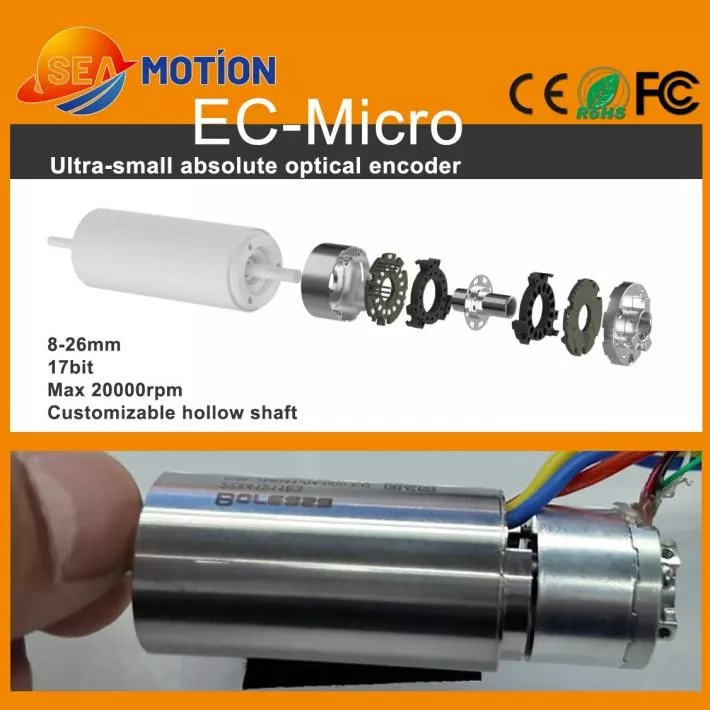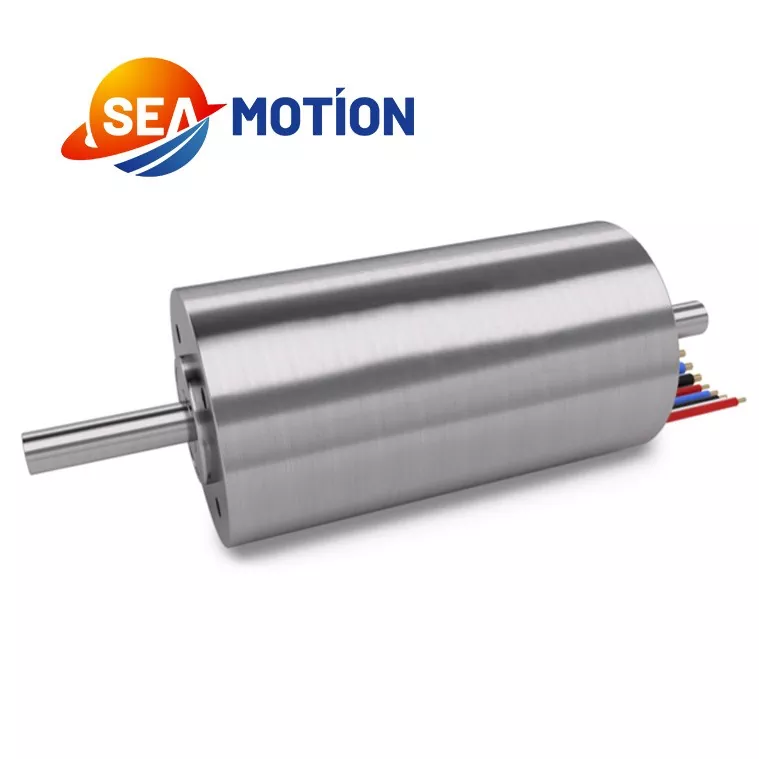

Jingyue provides advanced motion control solutions for demanding automation applications. The Absolute Multi Turn Photoelectric Encoder combines high-resolution optical feedback, multi-turn position measurement, and a compact design to help engineers achieve precise rotary positioning in space-constrained equipment.
An absolute multi-turn photoelectric encoder is a precision feedback device that measures both angular position within a single revolution and the number of revolutions completed by a rotating shaft. By combining optical sensing with absolute position encoding, it supports accurate motion monitoring in miniature servo motors, robotic hands, and advanced automation systems. The EC-Micro series associated with Jingyue's motion control supply chain offers an outer diameter range of 8–26 mm, 17-bit resolution, RS485 communication, and a maximum allowable speed of 20,000 RPM. This article explains its operating principles, technical specifications, application advantages, and selection considerations to help engineers identify a suitable encoder for their motion control requirements.
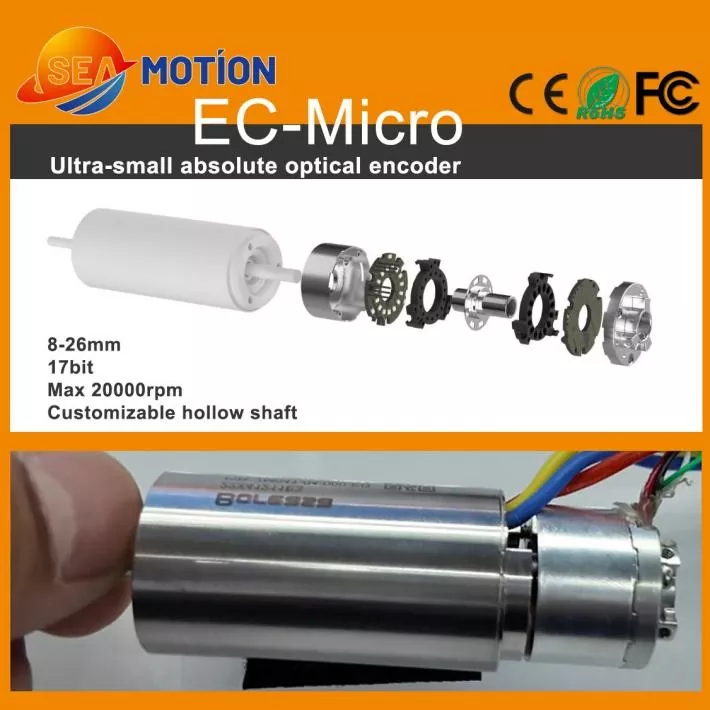
Table of Contents
- What Is an Absolute Multi Turn Photoelectric Encoder?
- How Does the Encoder Work?
- Key Technical Specifications
- Main Advantages for Precision Motion Control
- Industrial Applications and Use Cases
- How to Select the Right Encoder
- Installation and Integration Considerations
- Frequently Asked Questions
- Conclusion: Find the Right Motion Feedback Solution
What Is an Absolute Multi Turn Photoelectric Encoder?
An absolute multi-turn photoelectric encoder is an optical position sensor designed to measure shaft rotation across multiple revolutions. Unlike an incremental encoder, which primarily reports changes in position through pulses, an absolute encoder assigns a digital position value to a specific angular location. A multi-turn model also represents the number of completed rotations within its supported measurement range.
This combination makes the encoder particularly useful when a machine must identify its position accurately without relying solely on counting movement from a reference point. The controller can use the reported position to support positioning, synchronization, and closed-loop motion control.
The EC-Micro series is designed for compact installations where conventional feedback devices may occupy too much space. Its small form factor and customizable hollow-shaft structure help engineers integrate position feedback into miniature motors and densely arranged mechanical assemblies.
For additional product information, visit the Absolute Multi Turn Photoelectric Encoder product page.
How Does the Encoder Work?
A photoelectric encoder uses optical components to detect changes in the relative position of a coded disc or optical pattern. As the shaft rotates, the optical sensing system reads the pattern and converts the detected information into electrical signals. Internal processing electronics then produce digital position data for the connected controller.
In a multi-turn absolute encoder, the reported information includes two important elements:
- Single-turn position: Identifies the shaft's angular location within one complete revolution.
- Multi-turn position: Represents the accumulated number of revolutions within the encoder's specified measurement range.
These values allow the motion controller to interpret shaft position across a wider operating range. The exact method used to retain or recover turn information depends on the encoder's internal architecture and product design. Engineers should confirm the specified behavior following power interruption rather than assume that every multi-turn encoder operates identically.
Optical sensing can also offer advantages in environments where magnetic interference affects other sensing technologies. However, overall performance still depends on installation quality, electrical noise management, mechanical alignment, and the encoder's specified operating conditions.
Key Technical Specifications of the EC-Micro Series
Evaluating technical parameters before procurement helps engineers verify mechanical compatibility, communication requirements, and expected positioning performance. The following specifications are published for the EC-Micro miniature absolute multi-turn photoelectric encoder.
| Parameter | Specification | Engineering Consideration |
|---|---|---|
| Outer diameter | 8–26 mm | Supports compact equipment layouts |
| Reference dimensions | Ø19 mm × 14.5 mm | Confirm the selected configuration |
| Resolution | 17 bit | Provides fine position quantization |
| Output interface | RS485 | Verify protocol and controller compatibility |
| Baud rate | 2.5 Mbps | Confirm supported communication settings |
| Multi-turn range | 24 bit at 17-bit resolution; 16 bit at 23-bit resolution | Confirm the required configuration |
| Maximum allowable speed | 20,000 RPM | Observe mechanical and electrical limits |
| Supply voltage | DC 5 V ±5% | Provide a compatible power supply |
| Housing material | Aluminum | Consider mounting and thermal conditions |
| Protection rating | IP40 after installation | Evaluate dust and moisture exposure |
| Operating temperature | -20°C to +85°C | Check the actual equipment environment |
| Electrical connection | 5-pin PCB soldering interface | Plan the PCB layout and wiring process |
Important specification note: The published product information lists different multi-turn ranges for different resolution configurations. Confirm the required model, communication details, mechanical dimensions, and applicable accuracy specifications with the supplier before finalizing a design.
Main Advantages for Precision Motion Control
1. Compact Design for Space-Constrained Equipment
Miniaturization is a major challenge in modern robotics and precision machinery. The EC-Micro series offers outer diameters from 8 mm to 26 mm, helping designers incorporate position feedback into compact motor assemblies. Its hollow structure can also support mechanical integration where a shaft or central passage must remain available, subject to the selected configuration.
2. High-Resolution Position Feedback
The listed 17-bit resolution supports fine angular position representation. Higher resolution can help a controller identify smaller position changes, but it does not automatically guarantee equivalent system accuracy. Encoder accuracy, repeatability, shaft coupling, mechanical backlash, and control-loop performance must also be considered.
3. Multi-Turn Position Measurement
Single-turn feedback identifies angular position within one revolution, while multi-turn feedback extends position measurement across multiple rotations. This is useful in mechanisms where shaft movement continues through several revolutions and the controller needs both angular and turn information.
4. High-Speed Operation
With a published maximum allowable speed of 20,000 RPM, the encoder is intended for applications requiring high-speed rotary feedback. The actual operating limit must also account for the motor, coupling, mounting arrangement, communication cycle, and controller's ability to process position data.
5. Optical Sensing for Interference Management
Photoelectric sensing relies on optical detection rather than magnetic field measurement. This can be advantageous in systems where magnetic interference is a concern. Nevertheless, optical encoders still require suitable electrical shielding, grounding, mechanical protection, and installation practices.
Industrial Applications and Use Cases
The combination of miniature dimensions and absolute multi-turn feedback makes this encoder relevant to several advanced motion control applications.
Coreless Motors and Miniature Servo Systems
Coreless motors are used in applications that prioritize low inertia, compact construction, and responsive motion. A miniature encoder can provide shaft position feedback while preserving valuable installation space. Engineers should match the encoder's shaft interface, speed rating, and communication requirements to the motor assembly.
Robotic Dexterous Hands
Robotic hands contain multiple compact joints that must coordinate finger movement and respond to changing commands. Absolute position feedback can help the controller determine joint position and improve repeatable movement. The final result depends on the complete sensing, mechanical, and control architecture.
ZR Modules and Compact Motion Mechanisms
ZR modules and other precision mechanisms often integrate rotary and linear movement into a limited installation space. A compact encoder can support rotary feedback in the motor or transmission assembly, helping the control system coordinate motion according to the machine's operating requirements.
Other Potential Applications
- Miniature industrial automation equipment.
- Precision positioning mechanisms.
- Compact robotic joints and actuators.
- Small DC servo motor assemblies.
- Specialized equipment requiring multi-turn rotary feedback.
For a broader view of available feedback technologies, engineers can also explore the photoelectric encoder product category.
How to Select the Right Encoder
Choosing an encoder requires more than comparing resolution or maximum speed. A reliable selection process starts with the mechanical design and the control system's functional requirements.
- Define the measurement range. Determine the angular resolution required per revolution and the total number of revolutions that must be measured.
- Confirm the accuracy requirements. Distinguish between resolution, absolute accuracy, repeatability, and allowable position error.
- Check mechanical dimensions. Verify outer diameter, overall height, shaft diameter, hollow-bore dimensions, mounting screws, and permissible shaft displacement.
- Verify communication compatibility. Confirm the RS485 interface, supported communication protocol, baud rate, data format, and controller configuration.
- Evaluate electrical requirements. Check supply voltage, current consumption, connector design, PCB footprint, and electrical noise conditions.
- Review operating conditions. Match the operating temperature, protection rating, rotational speed, and installation environment to the application.
- Confirm power-loss behavior. Determine how the selected model handles multi-turn information during power interruption and restart.
When the application requires a different measurement technology, compare the design with an absolute single-turn photoelectric encoder or an absolute inductive encoder. These alternatives serve different feedback requirements and should be assessed against the actual system design.
Installation and Integration Considerations
Even a high-resolution encoder cannot compensate for poor mechanical installation or an incompatible controller. A structured integration process helps protect the sensor and improve the consistency of motion feedback.
- Mechanical alignment: Keep the encoder shaft and motor shaft properly aligned and within the specified radial and axial displacement limits.
- Secure mounting: Use the recommended mounting method and avoid excessive force on the housing or PCB connection.
- Power quality: Maintain the specified supply voltage and use appropriate grounding and noise-control practices.
- Communication testing: Verify the data format, baud rate, response timing, and controller-side error handling.
- Position validation: Compare reported position against a suitable reference during commissioning and across representative operating conditions.
- Environmental protection: Account for the published IP40 protection rating and provide additional enclosure protection if the application requires it.
For a new design, testing should cover startup, normal operation, direction changes, maximum expected speed, and recovery after power interruption. These checks help identify integration issues before the equipment enters production.
Frequently Asked Questions
1. What is the main difference between an absolute multi-turn encoder and an incremental encoder?
An absolute multi-turn encoder reports a coded position that includes angular position and turn information within its specified range. An incremental encoder reports movement through signal changes and generally requires a reference or a reliable counting strategy to establish absolute position. The most suitable choice depends on the application's startup behavior, positioning requirements, and controller design.
2. What resolution does the EC-Micro absolute multi-turn photoelectric encoder support?
The published EC-Micro specifications include a 17-bit resolution configuration. The product information also lists a 23-bit configuration associated with a different multi-turn range. Confirm the precise model and configuration before purchase, and remember that resolution is not the same as absolute accuracy.
3. Can this encoder operate at high rotational speeds?
The published maximum allowable speed is 20,000 RPM. Actual operating performance depends on the mechanical assembly, mounting tolerances, electrical interface, and controller. Engineers should validate the complete system under the intended operating conditions.
4. Which applications benefit most from a miniature multi-turn photoelectric encoder?
Typical applications include coreless motors, robotic dexterous hands, ZR modules, miniature servo systems, and compact automation equipment. These systems can benefit when installation space is limited but accurate rotary position feedback remains essential.
5. What should buyers confirm before ordering?
Buyers should confirm resolution, multi-turn range, communication protocol, dimensions, shaft compatibility, operating speed, supply voltage, protection rating, operating temperature, and power-loss behavior. Providing the motor model, installation drawing, and controller specifications can help the supplier recommend a compatible configuration.
Conclusion: Find the Right Motion Feedback Solution
An Absolute Multi Turn Photoelectric Encoder can support precise rotary feedback in compact, high-performance motion control systems. Its combination of optical sensing, multi-turn measurement, high-resolution output, and miniature construction makes it a relevant option for robotics, coreless motors, and space-constrained automation equipment. Successful implementation, however, depends on selecting the correct configuration and validating the complete mechanical and electrical system.
Jingyue's motion control solutions are designed to address demanding integration requirements across advanced automation applications. If you are evaluating a miniature encoder for a new project or upgrading an existing motion control system, review the product specifications and contact us to discuss your resolution, shaft dimensions, communication interface, and customization requirements. Share your application details to help identify a suitable encoder solution for your equipment.