
Kunshan develops motion-control solutions for demanding industrial environments, including the EtherNET IP Heavy Duty Encoder for networked position feedback. With a 58 mm housing, up to 18-bit single-turn resolution, 100 Mbit transmission and robust industrial protection, this encoder is designed for applications where accurate feedback and dependable communication are essential.
An EtherNET IP Heavy Duty Encoder combines absolute position sensing with industrial Ethernet communication, allowing automation systems to receive reliable rotational position data while simplifying integration into networked control architectures. Modern heavy-industry applications require more than basic feedback: equipment may face vibration, dust, moisture, electromagnetic interference, temperature fluctuations and continuous mechanical loads. A properly engineered encoder must therefore balance resolution, communication performance, mechanical durability and installation flexibility. This guide explains how EtherNET/IP-based heavy-duty encoders work, their major technical advantages, important specifications, application areas and selection considerations.
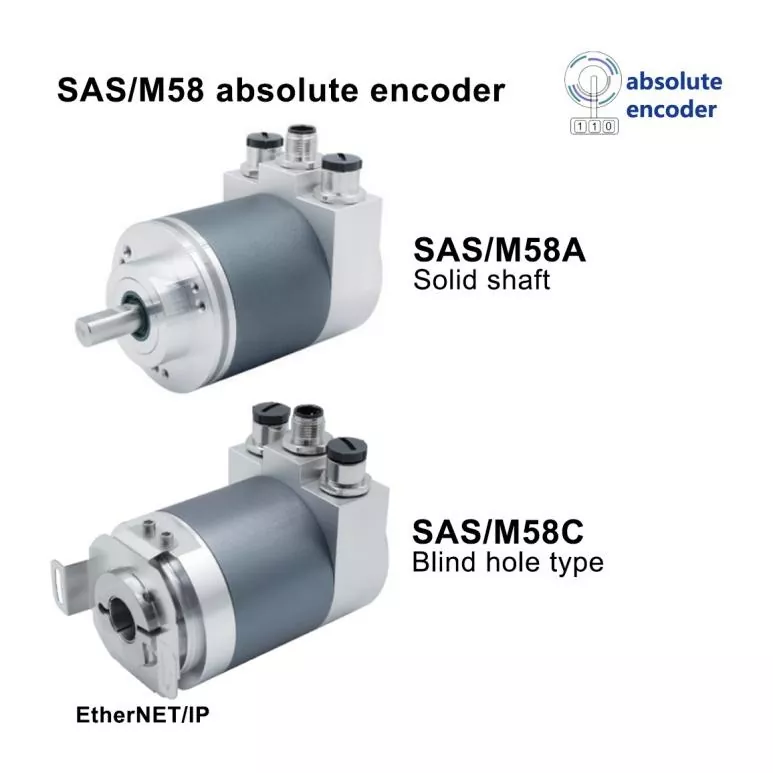
Table of Contents
- What Is an EtherNET IP Heavy Duty Encoder?
- Why Is EtherNET/IP Important for Heavy-Duty Motion Control?
- What Are the Key Technical Features?
- Key Specifications at a Glance
- Where Is It Used?
- How Should You Select the Right Encoder?
- Frequently Asked Questions
- Conclusion
What Is an EtherNET IP Heavy Duty Encoder?
An EtherNET IP Heavy Duty Encoder is an industrial rotary encoder designed to measure shaft position and communicate that information through an EtherNet/IP industrial Ethernet network. Unlike basic incremental feedback devices, an absolute encoder can provide defined position information without requiring the control system to reconstruct the position from pulses alone.
For demanding automation systems, the combination of absolute magnetic sensing and Ethernet-based communication provides a practical way to connect rotating machinery with PLCs, controllers and other networked devices. The 58 mm design described by Kunshan supports both single-turn and multi-turn position measurement, while configurable resolution allows the feedback system to match different motion-control requirements.
The encoder uses high-precision magnetic induction technology and supports a maximum EtherNet/IP transmission rate of 100 Mbit. Its programmable functions can include resolution, time base, speed, preset values, counting direction and IP address, giving engineers greater flexibility during commissioning and system integration.
Why Is EtherNET/IP Important for Heavy-Duty Motion Control?
Industrial machinery is increasingly connected through communication networks. Instead of treating each sensor as an isolated component, modern automation architectures exchange data between encoders, PLCs, drives, HMIs and supervisory systems.
EtherNet/IP is particularly useful when an encoder must become part of a larger industrial Ethernet infrastructure. The encoder can transmit position information through the network, supporting centralized monitoring and coordinated machine control.
- Network integration: Ethernet communication allows the encoder to become part of a connected automation architecture.
- Flexible expansion: Networked devices can be integrated into larger control systems as equipment requirements grow.
- Digital position feedback: Absolute position information supports accurate monitoring of rotating machinery.
- Remote diagnostics: Network communication can make equipment status and feedback information more accessible to control systems.
- Reduced wiring complexity: Industrial Ethernet architecture can simplify communication compared with multiple individual signal connections.
These advantages become especially valuable in steel processing, petrochemical production, mining, lifting systems and other environments where machines must operate continuously and reliably.
What Are the Key Technical Features?
1. High-Resolution Absolute Position Feedback
The encoder supports single-turn resolution up to 18 bits and multi-turn resolution up to 14 bits. Higher resolution allows the control system to distinguish smaller changes in rotational position, which is useful for applications requiring precise mechanical positioning.
2. 100 Mbit EtherNet/IP Communication
The encoder uses EtherNet/IP industrial Ethernet communication with a transmission rate of up to 100 Mbit. This provides a network-based feedback channel suitable for modern industrial control systems and machine-level communication.
3. Heavy-Duty Mechanical Construction
A heavy-duty encoder must withstand considerably more demanding conditions than a general-purpose sensing device. The available configuration uses an aluminum housing, with stainless steel available as an option. The design also supports radial and axial cable outlet configurations.
4. Protection Against Electrical and Installation Risks
Reverse-polarity protection and short-circuit protection help reduce the consequences of wiring or installation errors. The encoder also incorporates protection against lightning and static electricity, which can be valuable in electrically demanding industrial environments.
5. Flexible Mechanical Configuration
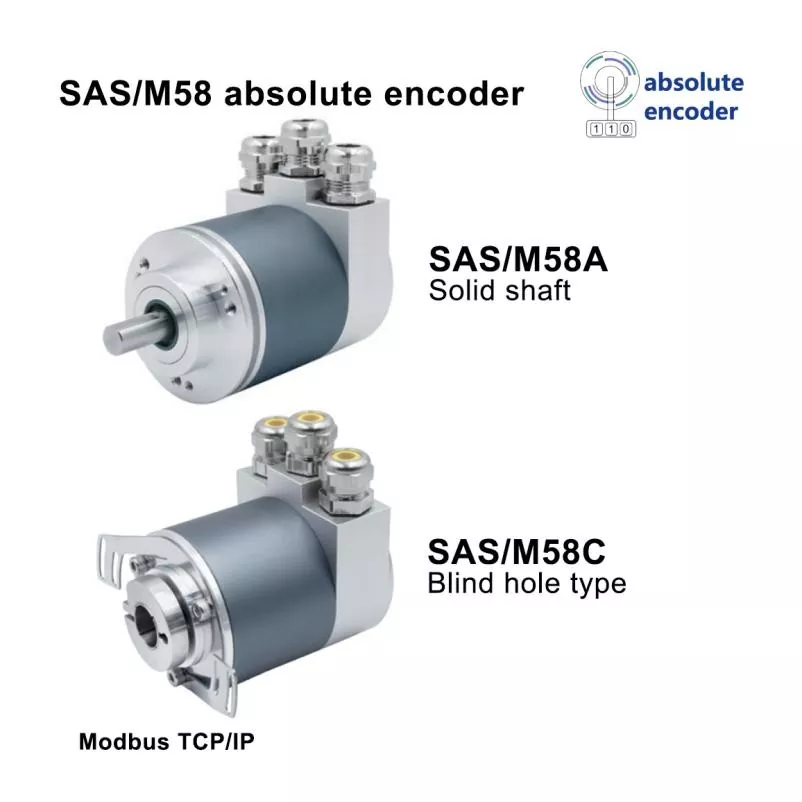
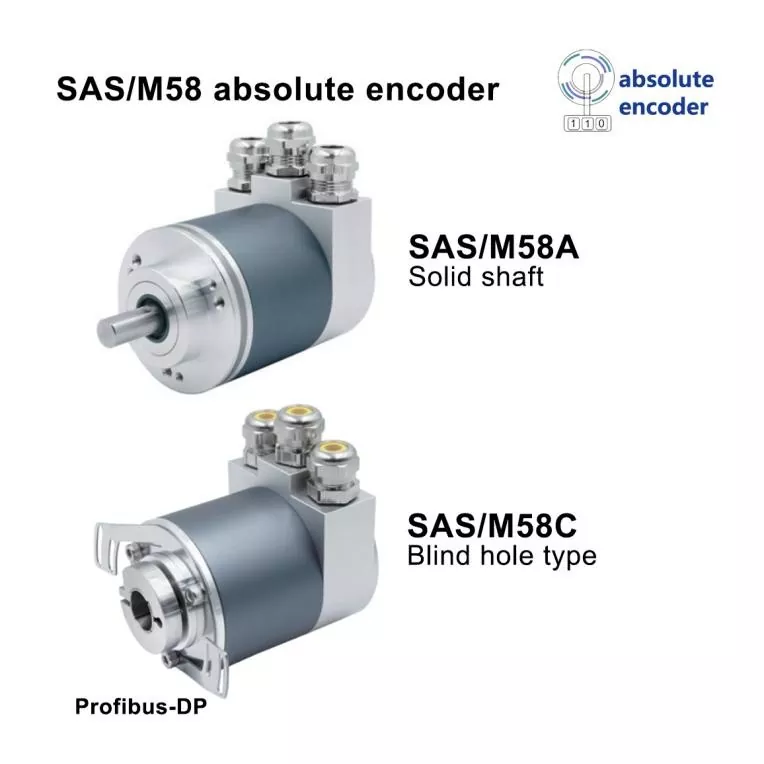
The 58 mm encoder platform supports solid-shaft and blind-hole configurations. Shaft sizes of 6, 8, 10, 12 and 15 mm can be customized, while multiple connector and flange configurations help engineers adapt the encoder to different machine layouts.
Key Specifications at a Glance
The following specifications illustrate why this encoder can serve demanding networked motion-control applications:
| Parameter | Specification |
|---|---|
| Encoder Size | 58 mm |
| Communication Interface | EtherNet/IP |
| Protocol | CIP (Common Industrial Protocol) |
| Transmission Rate | 100 Mbit |
| Single-Turn Resolution | 12–18 bit |
| Multi-Turn Resolution | Up to 14 bit |
| Power Supply | 10–30 VDC |
| Maximum Speed | 6,000 rpm |
| Radial Shaft Load | 200 N |
| Axial Shaft Load | 100 N |
| Protection | IP65/IP66; higher protection configurations available |
| Operating Temperature | -30°C to +85°C; -40°C to +85°C optional |
| Connection | 3 × M12 connector |
Actual encoder selection should always be based on the complete machine environment, including shaft dimensions, rotational speed, mechanical loading, temperature, contamination level, communication architecture and installation space.
Where Is It Used?
Heavy-duty Ethernet encoders are most valuable where position feedback must remain reliable while machinery operates under demanding industrial conditions.
Steel and Metallurgical Equipment
Steel production equipment can involve high vibration, mechanical impact, heat and continuous operation. An absolute encoder can provide rotational feedback for rollers, processing machinery and automated production equipment.
Petrochemical and Refinery Systems
Petrochemical facilities require dependable monitoring and automation. Networked position feedback can support equipment status monitoring, automated mechanisms and remote control architectures.
Mining and Heavy Machinery
Mining equipment is exposed to dust, vibration and mechanical stress. Heavy-duty encoder construction combined with industrial Ethernet communication can support reliable position feedback for intelligent machinery.
Lifting and Hoisting Equipment
Large lifting systems require accurate rotational feedback to coordinate mechanical movement. Absolute position data can contribute to more predictable positioning and machine monitoring.
Power and Paper Manufacturing
Power-generation equipment and automated papermaking lines can also benefit from networked encoder feedback where continuous machine operation and centralized control are important.
How Should You Select the Right Encoder?
Choosing an industrial encoder should begin with the application rather than simply the communication protocol. A suitable model needs to satisfy both electrical and mechanical requirements.
- Check shaft compatibility: Confirm shaft diameter, solid-shaft or blind-hole requirements, flange dimensions and allowable mechanical loads.
- Determine resolution: Select the required single-turn and multi-turn resolution according to positioning accuracy and controller requirements.
- Verify network compatibility: Ensure the PLC or industrial controller supports the required EtherNet/IP and CIP communication architecture.
- Evaluate environmental conditions: Consider temperature, moisture, dust, oil, vibration, impact and electromagnetic interference.
- Confirm rotational speed: Make sure the encoder's maximum allowable speed exceeds the actual machine speed with an appropriate operating margin.
- Consider installation: Review connector type, cable outlet direction, available mounting space and maintenance accessibility.
- Review protection requirements: Match the enclosure and sealing level to the actual environment instead of relying only on nominal machine specifications.
For engineers comparing different products, it is also useful to evaluate technical support, customization capability, quality inspection, documentation and after-sales service. These factors can have a significant effect on the total project cost and long-term reliability.
Frequently Asked Questions
What is the maximum communication speed of the encoder?
The EtherNet/IP interface supports a transmission rate of up to 100 Mbit. This makes the encoder suitable for integration into industrial Ethernet control architectures.
Does the encoder support both single-turn and multi-turn measurement?
Yes. The encoder supports both single-turn and multi-turn absolute position measurement. Single-turn resolution can reach 18 bits, while multi-turn resolution can reach 14 bits.
What power supply does the encoder require?
The specified power supply range is 10–30 VDC, making it compatible with common industrial control power architectures.
Can the shaft size and mechanical configuration be customized?
Yes. Shaft sizes including 6, 8, 10, 12 and 15 mm can be customized. Different flange, connector and cable outlet configurations can also be selected according to installation requirements.
What environments are suitable for this type of encoder?
It is intended for demanding industrial applications such as steel manufacturing, petrochemical facilities, heavy engineering machinery, mining equipment, lifting systems, power plants and automated production lines. The appropriate protection and material configuration should be selected according to the actual site conditions.
Conclusion
An EtherNET IP Heavy Duty Encoder can provide a strong combination of absolute position feedback, industrial Ethernet connectivity, high resolution and rugged mechanical performance. With features such as up to 18-bit single-turn resolution, 100 Mbit communication, flexible shaft configurations and industrial protection, it is well suited to networked heavy-duty automation where reliable feedback is critical. If you are evaluating encoder specifications for a new machine, upgrading an existing automation system or developing a customized motion-control solution, contact us to discuss your application requirements, mechanical configuration and communication needs with the Kunshan engineering team.