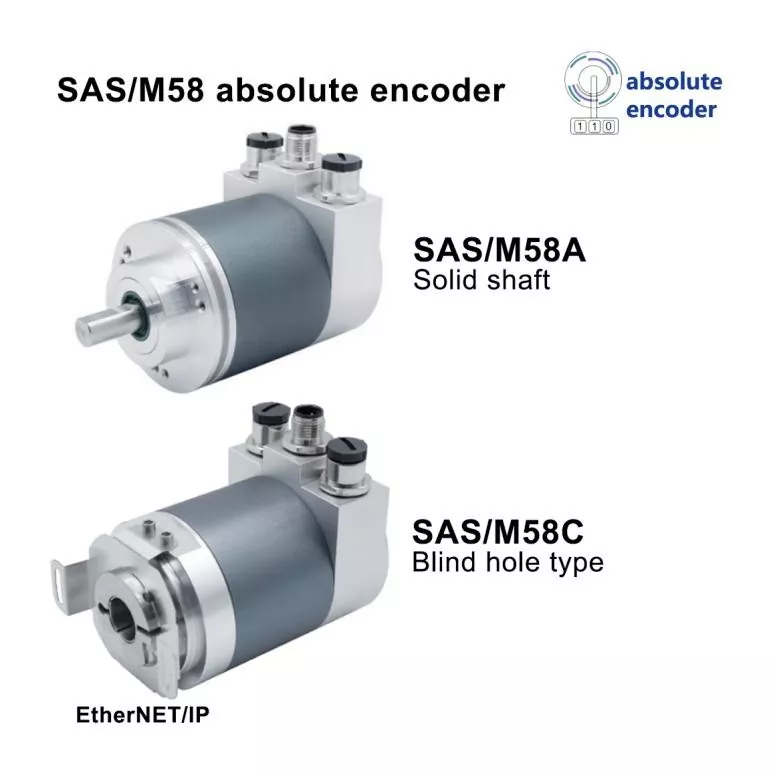

For demanding industrial automation, Jingyue Kunshan provides the Modbus Heavy Duty Encoder as a reliable solution for accurate position feedback, equipment monitoring, and motion control. Designed for harsh environments, this 58 mm encoder combines an industrial metal housing, IP65-IP68 protection, high-resolution magnetic sensing, and Ethernet Modbus TCP communication to support demanding steel, petrochemical, mining, construction, and manufacturing applications.
A heavy-duty encoder does more than measure shaft position. In industrial automation, it acts as a critical feedback device that allows controllers to understand the position, rotation, and movement of machinery. When equipment operates around dust, oil mist, vibration, electromagnetic interference, temperature fluctuations, or continuous mechanical loads, conventional feedback devices may not provide sufficient reliability.
The Modbus Heavy Duty Encoder addresses these challenges through a reinforced 58 mm structure, aluminum alloy or optional stainless-steel housing, IP65-IP68 protection, absolute single-turn and multi-turn measurement, and Ethernet Modbus TCP communication. With single-turn resolution available up to 18 bits, multi-turn resolution up to 14 bits, and transmission rates of 10/100 Mbit, it provides a practical feedback solution for modern industrial control systems.
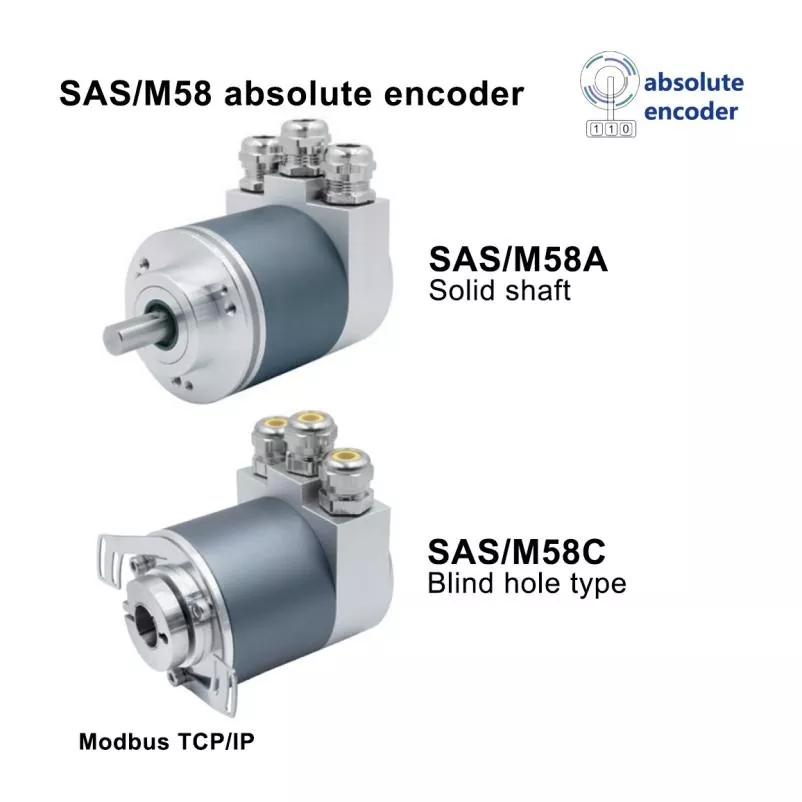
Table of Contents
- Why Does Heavy-Duty Encoder Design Matter in Industrial Automation?
- Why Choose Modbus Communication for Industrial Encoder Feedback?
- What Are the Key Features of a Modbus Heavy Duty Encoder?
- What Technical Parameters Should Buyers Evaluate?
- Where Can a Modbus Heavy Duty Encoder Be Used?
- How Should Engineers Select the Right Encoder?
- How Does It Improve Industrial Reliability?
- Frequently Asked Questions
Why Does Heavy-Duty Encoder Design Matter in Industrial Automation?
Industrial machines rarely operate in laboratory conditions. Steel production lines, oil-field equipment, refinery machinery, mining systems, paper-processing equipment, and large construction machines can expose feedback components to severe mechanical and environmental stresses.
An encoder installed in these environments must continuously convert mechanical rotation into dependable digital position information. If the feedback signal becomes unstable, the controller may lose accurate information about machine position or speed, potentially affecting production quality and equipment safety.
A heavy-duty design therefore needs to address several factors simultaneously:
- Environmental protection: Resistance to dust, water, oil mist, and other contaminants.
- Mechanical durability: Ability to withstand vibration, impact, and shaft loading.
- Electrical reliability: Stable communication under industrial electromagnetic interference.
- Position accuracy: Sufficient resolution for the motion-control requirements of the machine.
- Long-term operation: Reliable performance during continuous industrial production.
The referenced encoder uses a 58 mm housing and offers IP65 or IP68 protection, while its mechanical design supports radial shaft loads up to 200 N and axial loads up to 100 N. It is also specified for impact resistance of 1000 m/s² over 6 ms and vibration resistance up to 20g. :contentReference[oaicite:0]{index=0}
Why Choose Modbus Communication for Industrial Encoder Feedback?
Communication compatibility is an important consideration when integrating an encoder into an existing automation architecture. Modbus is widely recognized in industrial control environments, making it a practical choice where controllers, PLCs, industrial computers, and other devices need to exchange structured data.
The featured Modbus Heavy Duty Encoder uses Ethernet Modbus TCP communication and supports TCP/IP and UDP. Its Ethernet interface provides a transmission rate of 10/100 Mbit, allowing encoder feedback to become part of an industrial network rather than relying solely on traditional point-to-point signal transmission. :contentReference[oaicite:1]{index=1}
This approach can offer several practical advantages:
- Improved compatibility with industrial Ethernet architectures.
- Convenient integration with compatible PLC and automation systems.
- Digital transmission of position information.
- Flexible configuration and programming functions.
- Reduced complexity when multiple devices share an industrial communication network.
For buyers comparing different encoder technologies, communication protocol should be evaluated together with resolution, mechanical dimensions, environmental protection, electrical specifications, and controller compatibility rather than considered independently.
What Are the Key Features of a Modbus Heavy Duty Encoder?
The encoder combines sensing technology, industrial networking, mechanical protection, and configurable feedback functions into one compact device. According to the product specifications, its major features include the following:
- 58 mm industrial housing: Available with a solid-shaft or blind-hole configuration.
- High-resolution magnetic sensing: Single-turn resolution can reach 18 bits, while multi-turn resolution can reach 14 bits.
- Absolute measurement: Supports both single-turn and multi-turn encoder configurations.
- Ethernet Modbus TCP: Designed for network-based industrial communication.
- Wide power supply: Operates from 10 to 30 VDC.
- Industrial protection: IP65 and IP68 options are available.
- Electrical protection: Includes reverse-polarity, short-circuit, lightning, and static-electricity protection.
- High-speed operation: Maximum rotational speed is specified at 6000 rpm.
- Temperature adaptability: Standard operating temperature is -30°C to +85°C, with -40°C to +85°C available as an option.
Another important characteristic is its permanent absolute multi-turn position technology. This allows position information to be retained without relying on continuous power availability, helping reduce the risk of losing position information after power interruption. :contentReference[oaicite:2]{index=2}
What Technical Parameters Should Buyers Evaluate?
Choosing an industrial encoder based only on the communication protocol can result in compatibility problems later. Procurement teams and automation engineers should examine the complete technical specification before selecting a model.
| Parameter | Specification | Why It Matters |
|---|---|---|
| Housing Diameter | 58 mm | Determines mechanical installation compatibility |
| Housing Material | Aluminum; stainless steel optional | Supports demanding industrial environments |
| Communication | Ethernet Modbus TCP | Enables industrial network integration |
| Single-Turn Resolution | Up to 18 bit | Provides detailed angular position feedback |
| Multi-Turn Resolution | Up to 14 bit | Supports extended rotational position measurement |
| Power Supply | 10–30 VDC | Fits common industrial DC power architectures |
| Transmission Rate | 10/100 Mbit | Supports Ethernet-based data communication |
| Maximum Speed | 6000 rpm | Defines the upper rotational operating range |
| Protection Rating | IP65 / IP68 | Improves resistance to dust and water exposure |
| Operating Temperature | -30°C to +85°C | Supports demanding industrial temperature conditions |
| Starting Torque | <0.05 Nm | Helps minimize mechanical loading at startup |
| Shaft Load | Radial 200 N; axial 100 N | Provides guidance for mechanical installation design |
These specifications are based on the manufacturer's published product information. Actual system selection should also consider the machine's mechanical interface, controller configuration, communication architecture, environmental conditions, and required feedback performance. :contentReference[oaicite:3]{index=3}
Where Can a Modbus Heavy Duty Encoder Be Used?
A major strength of this encoder concept is its suitability for applications where environmental durability and digital position feedback are both important. The published application information identifies several heavy-industry sectors.
Steel and Metallurgy
Steel production can involve high temperatures, dust, vibration, and demanding continuous-operation cycles. A sealed heavy-duty encoder can provide position feedback for production lines, material handling equipment, and automated machinery.
Petrochemical and Oil Field Equipment
Petrochemical facilities and oil-field operations may expose equipment to oil mist, dust, vibration, and electromagnetic interference. An encoder with strong environmental protection and industrial communication capability can support equipment monitoring and automatic control.
Mining Machinery
Mining equipment requires components capable of working under severe mechanical and environmental conditions. IP-rated protection, impact resistance, vibration resistance, and robust housing are particularly important when selecting position-feedback equipment.
Heavy Construction Machinery
Large construction machinery often depends on accurate position information for automated movement and control. A heavy-duty encoder can be used for rotary position monitoring and feedback where conventional sensors may not provide sufficient environmental durability.
Paper and Industrial Production Lines
Continuous production equipment benefits from dependable feedback because unexpected sensor failure can interrupt production. The encoder can support position monitoring and automatic control in industrial production systems.
The manufacturer specifically lists steel manufacturing, metallurgy, papermaking, petrochemical facilities, oil refineries, oil fields, mining machinery, large hoisting equipment, power-generation units, and heavy construction machinery among relevant applications. :contentReference[oaicite:4]{index=4}
How Should Engineers Select the Right Encoder?
When sourcing a Modbus Heavy Duty Encoder from a China manufacturer or supplier, engineers should evaluate the complete application rather than focusing exclusively on price or communication protocol.
- Confirm mechanical dimensions. Check the flange, shaft type, shaft diameter, mounting method, and available installation space.
- Define resolution requirements. Determine whether 12-bit, 13-bit, 16-bit, or higher single-turn resolution is required.
- Determine single-turn or multi-turn operation. Applications involving extended rotational travel may require multi-turn absolute feedback.
- Check environmental conditions. Consider dust, water, oil, vibration, impact, temperature, and corrosion.
- Verify communication compatibility. Confirm that Ethernet Modbus TCP is supported by the PLC, controller, or industrial computer.
- Evaluate electrical protection. Reverse polarity, short-circuit, lightning, and static-electricity protection can be important in industrial installations.
- Consider customization. Shaft dimensions, housing material, temperature range, connectors, and mechanical configuration may need to match the equipment.
The published model supports 6, 8, 10, 12, and 15 mm spindle sizes as customizable options, along with three M12 connectors and radial-side or axial-rear cable outlet configurations. :contentReference[oaicite:5]{index=5}
How Does It Improve Industrial Reliability?
Reliability in industrial motion control comes from the combination of accurate sensing, mechanical durability, electrical protection, and appropriate system integration. The Modbus Heavy Duty Encoder is designed around these four areas.
Its magnetic induction technology provides absolute position feedback, while the reinforced housing helps protect internal components from harsh environmental conditions. The encoder also incorporates anti-interference characteristics, status indication, and electrical protection functions to reduce the effects of installation errors and industrial electrical disturbances. :contentReference[oaicite:6]{index=6}
Long-term reliability also depends on manufacturing and validation practices. The manufacturer's published information states that its products undergo 24–48 hours of high-temperature continuous aging testing. This type of testing is intended to verify stable operation during extended use before deployment. :contentReference[oaicite:7]{index=7}
For industrial buyers, this matters because the cost of an encoder should not be evaluated separately from downtime, maintenance requirements, installation labor, and the potential impact of inaccurate position feedback.
Frequently Asked Questions
What is a Modbus Heavy Duty Encoder?
A Modbus Heavy Duty Encoder is an industrial position-feedback device designed for demanding environments. It combines robust mechanical construction with Modbus-based digital communication to provide position information to industrial control systems.
What communication protocol does this encoder use?
The referenced model uses Ethernet Modbus TCP and supports TCP/IP and UDP communication. Its specified transmission rate is 10/100 Mbit. :contentReference[oaicite:8]{index=8}
What is the maximum resolution?
The encoder supports single-turn resolution up to 18 bits and multi-turn resolution up to 14 bits. Different resolution configurations can be selected according to application requirements. :contentReference[oaicite:9]{index=9}
Can it operate in harsh environments?
Yes. The encoder is designed for heavy industrial environments and is available with IP65 or IP68 protection. Its specifications also include resistance to vibration and impact, with a standard operating temperature range of -30°C to +85°C. :contentReference[oaicite:10]{index=10}
What industries commonly use this type of encoder?
Typical applications include steel and metallurgy, petrochemical facilities, oil fields, mining, papermaking, power-generation equipment, hoisting machinery, and heavy construction equipment.
Can the encoder be customized?
Customization options include shaft dimensions, housing material, temperature range, mechanical configuration, connector arrangement, and cable outlet direction. Engineers should provide the machine's installation and communication requirements when requesting a customized solution.
Final Thoughts
A reliable encoder is fundamental to accurate industrial motion feedback, particularly when machinery operates under dust, vibration, temperature variation, moisture, electromagnetic interference, or continuous production conditions. With its 58 mm industrial construction, IP65-IP68 protection, absolute single-turn and multi-turn measurement, high-resolution magnetic sensing, electrical protection functions, and Ethernet Modbus TCP communication, the Modbus Heavy Duty Encoder provides a strong option for demanding automation applications. If you are evaluating encoder specifications, planning a new automation system, or replacing an existing feedback device, contact us to discuss your application requirements, mechanical configuration, communication system, customization options, and sourcing needs.