
In modern industrial automation, accurate position feedback and dependable signal transmission are essential for maintaining production efficiency and equipment safety. Jingyue provides advanced SSI Heavy Duty Encoder solutions designed to deliver stable, high-accuracy position measurement in demanding industrial environments. Featuring a robust mechanical structure, synchronous serial communication, absolute multi-turn measurement, and excellent environmental resistance, this encoder is an ideal choice for heavy machinery, steel production lines, mining equipment, petrochemical facilities, and other applications where operational reliability is critical.
An SSI Heavy Duty Encoder is an industrial position feedback device designed to provide reliable absolute position information through a Synchronous Serial Interface (SSI). Compared with conventional feedback solutions, it offers deterministic data transmission, strong anti-interference performance, and simplified communication integration. This article explores its operating principles, technical characteristics, industrial applications, selection considerations, and maintenance requirements. It also explains how Jingyue's 58mm SSI encoder helps manufacturers improve motion control reliability in harsh operating conditions.
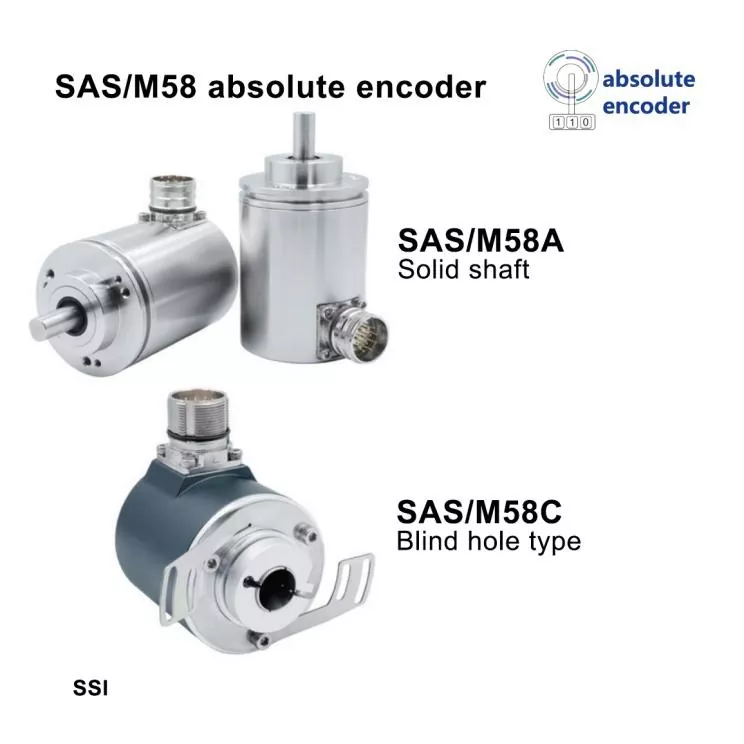
An SSI Heavy Duty Encoder is an absolute rotary encoder that uses the Synchronous Serial Interface to transmit position information to a connected controller. It is specifically engineered for industrial machinery operating under challenging conditions, including vibration, mechanical shock, moisture, dust, temperature fluctuations, and electromagnetic interference.
Unlike an incremental encoder, which typically generates pulses representing relative movement, an absolute encoder provides a defined digital position value. This allows the control system to identify the actual shaft position without relying solely on accumulated pulse counts.
The SSI communication method synchronizes data transmission through clock signals generated by the receiving controller. Position information is transmitted serially, allowing the encoder and controller to exchange data through a straightforward interface.
For heavy industrial equipment, this combination provides several practical advantages:
These characteristics make SSI technology particularly valuable in machinery where unexpected position loss or unstable feedback could interrupt production.
The Synchronous Serial Interface is designed to transmit digital data between an encoder and a motion controller using synchronized clock and data signals. The controller generates the clock signal, while the encoder responds by transmitting the corresponding position information.
This communication structure provides a straightforward way to obtain absolute position data without requiring complicated industrial fieldbus protocol processing.
SSI uses a clock-driven communication process. Because data transmission is synchronized with the controller's clock, the receiving system can obtain position information in a predictable manner. This is beneficial for motion control applications that require consistent feedback timing.
Industrial environments often contain electrical noise generated by motors, variable-frequency drives, switching equipment, and high-power electrical installations. Differential RS422 signal transmission helps improve noise immunity over suitable cable connections.
For long-term reliability, proper shielded cabling, grounding, and cable routing remain important parts of the complete installation.
SSI offers a relatively simple communication architecture. It is suitable for industrial control systems equipped with compatible SSI interfaces and reduces the need for complex communication protocol interpretation.
For additional information about encoder technologies, explore Jingyue's Heavy Duty Encoder product category.
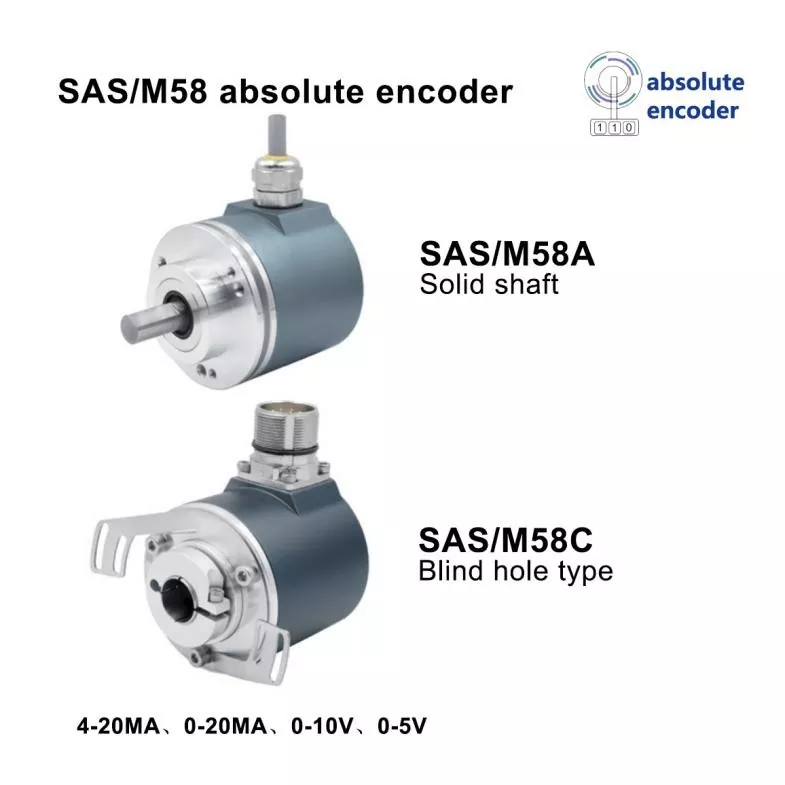
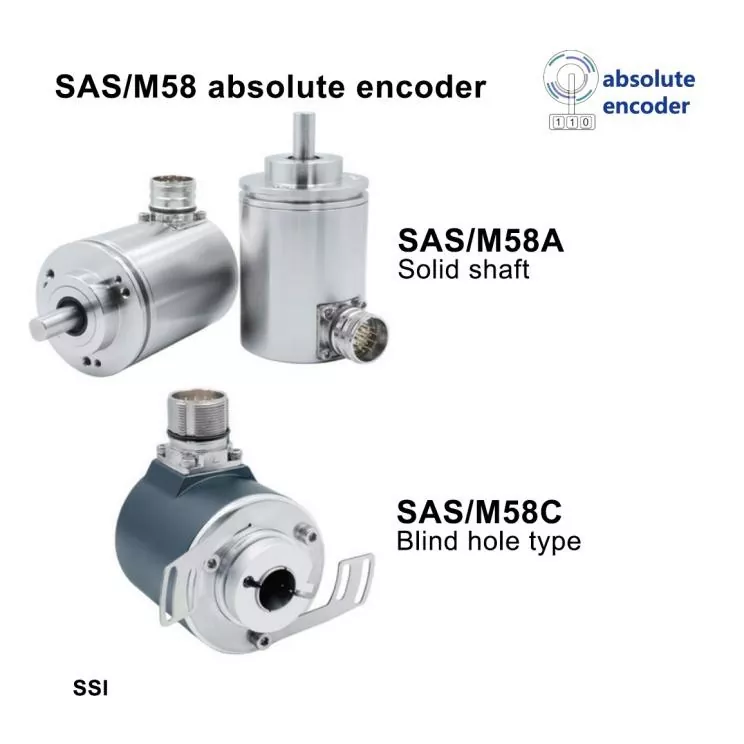
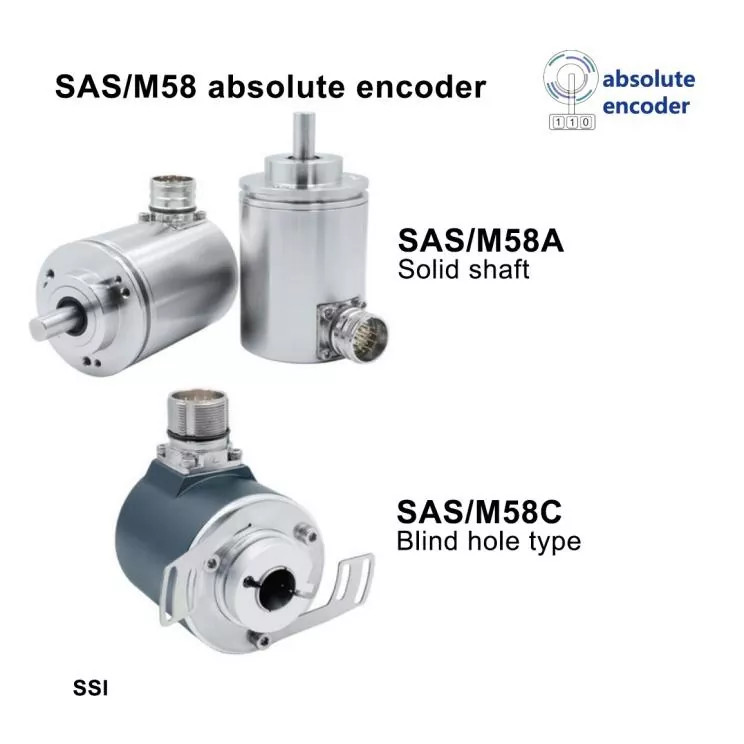
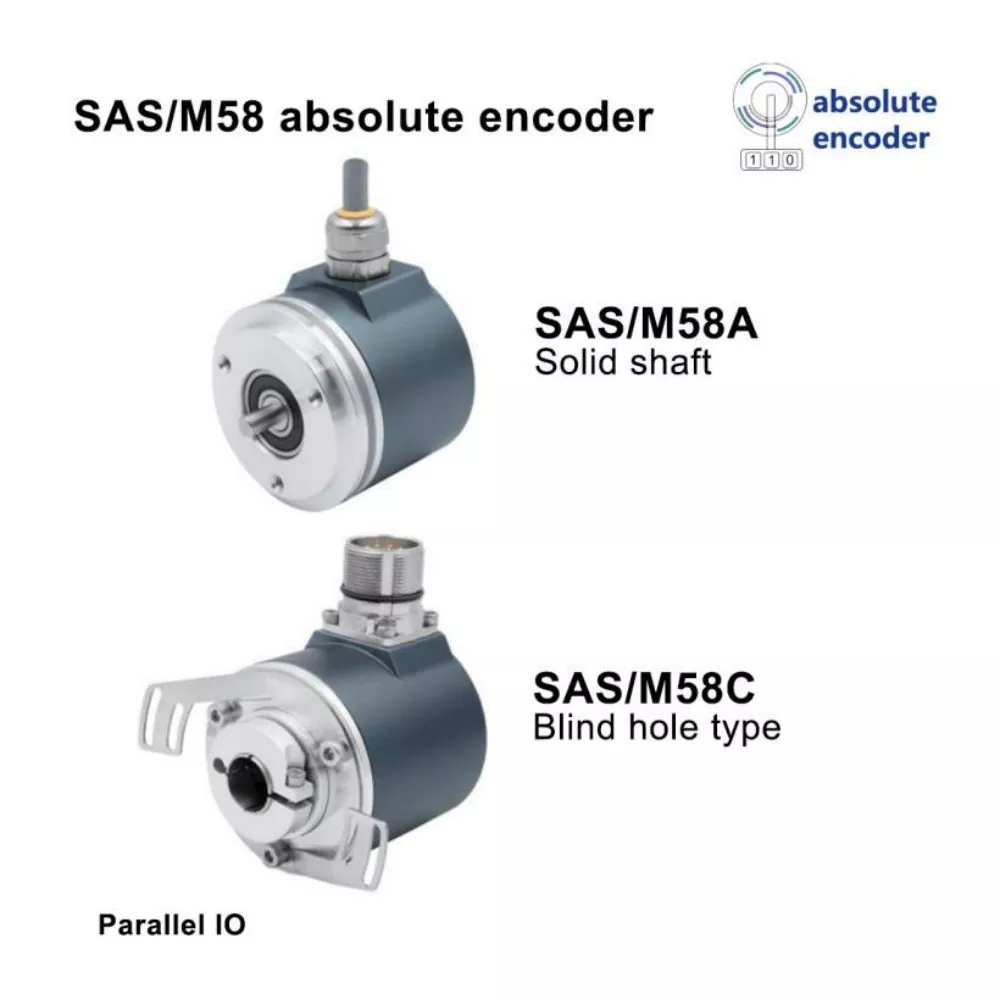
Jingyue's 58mm SSI Heavy Duty Encoder is developed for demanding industrial applications that require dependable position feedback and mechanical durability. The SAS/M58A and SAS/M58C models offer different mechanical configurations to accommodate different installation requirements.
The encoder features a 58mm housing with aluminum alloy as the standard shell material and stainless steel as an optional material. This construction provides a solid mechanical foundation for industrial applications involving vibration, impact, and environmental exposure.
Available configurations include solid shafts with clamping flanges and blind-hole shaft designs. Shaft connection sizes of 6mm, 8mm, 10mm, 12mm, and 15mm are supported, with customization options available.
Depending on the selected configuration, the encoder offers IP65 or IP68 protection. These protection levels help prevent dust and water ingress when the product is correctly installed and used within its specified conditions.
This makes it suitable for equipment exposed to industrial dust, moisture, water splashes, and other challenging environmental factors.
The encoder supports single-turn and multi-turn absolute measurement. Its standard single-turn resolution options include 12-bit, 13-bit, and 16-bit configurations, while higher resolutions are available according to the product specifications.
Absolute multi-turn magnetic encoding technology retains position information through power interruptions, helping reduce the need for repeated homing procedures.
Different cable and connector configurations are available to accommodate various industrial control cabinet layouts and installation conditions.
Optional configurations include:
The following table summarizes important technical parameters of Jingyue's 58mm SSI Heavy Duty Encoder. Actual configuration and available options should be confirmed before ordering.
| Parameter | Specification |
|---|---|
| Model | SAS/M58A / SAS/M58C |
| Housing Diameter | 58mm |
| Flange Type | Solid shaft with clamping flange / Blind hole |
| Shaft Size | 6mm, 8mm, 10mm, 12mm, 15mm, customizable |
| Housing Material | Aluminum alloy / Optional stainless steel |
| Signal Output | SSI / SSI + Incremental |
| Output Driver | SSI (RS422) / Incremental (RS422) |
| Absolute Measurement | Single-turn / Multi-turn |
| Single-Turn Resolution | 12-bit, 13-bit, 16-bit; higher options available |
| Maximum Response Frequency | 2MHz |
| Clock Frequency | 100kHz–2MHz |
| Power Supply | Standard 10–30VDC; 5VDC or 5–30VDC options |
| Maximum Rotational Speed | 6000rpm |
| Power Consumption | ≤1.5W |
| Protection Rating | IP65 / IP68 |
| Operating Temperature | -30°C to +85°C; optional -40°C to +85°C |
| Impact Resistance | 1000m/s², 6ms (100g) |
| Vibration Resistance | 20g |
| Starting Torque | <0.01Nm |
| Maximum Radial Load | 200N |
| Maximum Axial Load | 100N |
These specifications demonstrate the encoder's suitability for industrial position measurement applications. However, selecting the correct model requires evaluating the actual operating speed, mounting structure, electrical interface, temperature range, and environmental exposure of the target equipment.
Industrial encoders are frequently installed directly on motors, gearboxes, rotating shafts, and other mechanical components. Unlike equipment operating in controlled laboratory conditions, heavy industrial machinery may experience continuous vibration, sudden mechanical impacts, temperature variations, and exposure to contaminants.
A standard encoder may not provide sufficient mechanical protection or environmental resistance for these conditions. A heavy-duty design addresses these challenges through stronger housing structures, protective sealing, reliable internal components, and flexible installation arrangements.
Encoder failures can cause incorrect position feedback, motion interruptions, production delays, and additional maintenance costs. A suitable heavy-duty encoder helps reduce the risks associated with environmental exposure and mechanical stress.
Stable position signals help industrial controllers coordinate motors, rollers, lifting mechanisms, and other moving components. This is particularly important for applications involving synchronized motion or repeated positioning operations.
Heavy-duty equipment is often expected to operate for extended periods. Reliable mechanical protection and suitable electrical performance help maintain consistent feedback throughout demanding production cycles.
When evaluating an encoder, buyers should consider the entire operating environment rather than focusing exclusively on resolution or communication type.
Because of its rugged construction and reliable absolute position feedback, an SSI Heavy Duty Encoder can serve a wide range of industrial applications.
Steel production lines contain heavy rollers, transmission systems, lifting equipment, and moving mechanical structures. Position feedback is essential for coordinating material movement and maintaining equipment synchronization.
SSI encoders can support:
Petrochemical facilities frequently operate in environments involving humidity, temperature changes, vibration, and potentially corrosive substances. Suitable encoder protection and material selection are important for maintaining reliable equipment operation.
SSI absolute encoders can provide position feedback for extraction, transmission, and refining machinery when their electrical and environmental specifications match the installation requirements.
Mining equipment and construction machinery often experience high mechanical loads, vibration, dust, and impact. Reliable rotary position feedback supports the control of rotating and moving mechanisms.
Potential applications include lifting equipment, mining machinery, heavy-duty transmission systems, and industrial positioning mechanisms.
Power generation facilities depend on stable equipment operation and dependable control feedback. Absolute encoder technology can help monitor the position of selected rotating or positioning mechanisms in power plant equipment.
Large-scale papermaking systems require coordinated operation between rollers, conveyors, and other mechanical components. Stable position feedback helps support synchronization and operational consistency throughout continuous production processes.
| Industrial Sector | Typical Equipment | Encoder Function |
|---|---|---|
| Steel Manufacturing | Rolling mills and transmission rollers | Position tracking and synchronization |
| Petrochemical Industry | Refining and extraction machinery | Absolute position feedback |
| Mining | Heavy lifting and mining equipment | Rotational position monitoring |
| Construction Machinery | Hoisting and positioning mechanisms | Motion and stroke feedback |
| Power Generation | Industrial rotating equipment | Position monitoring |
| Papermaking | Rollers and production machinery | Motion coordination |
Choosing the correct encoder is essential for ensuring compatibility, measurement accuracy, and long-term operational reliability. Before purchasing an SSI Heavy Duty Encoder, engineers and procurement professionals should evaluate several technical factors.
Resolution determines the number of distinguishable position values within one revolution. Higher resolution can provide finer position measurement, but the actual requirement depends on the mechanical system and control application.
For example, a 12-bit encoder provides 4,096 distinguishable positions per revolution, while a 16-bit encoder provides 65,536. Engineers should select a resolution that matches the required positioning performance without unnecessarily increasing system complexity.
Single-turn encoders identify the shaft's angular position within one revolution. Multi-turn absolute encoders additionally track the number of completed revolutions.
Multi-turn functionality is particularly useful for lifting systems, long-travel positioning mechanisms, and machinery that needs to retain position information after power interruptions.
Mechanical dimensions directly influence installation feasibility. Before placing an order, verify:
Consider the actual operating temperature, humidity, dust exposure, water exposure, vibration, and mechanical impact. Select an appropriate IP protection rating and housing material according to the installation environment.
Check the controller's SSI interface, supply voltage, RS422 signal requirements, clock frequency, connector configuration, and data coding format. Gray code and binary code are available encoding options, but the selected format must be supported by the receiving system.
For specialized machinery, standard configurations may not satisfy every installation requirement. Working with an experienced manufacturer can help address non-standard shaft dimensions, cable arrangements, electrical configurations, and application-specific performance requirements.
Even a high-performance encoder requires correct installation and maintenance to achieve its expected service life. Following appropriate installation procedures helps reduce mechanical stress and electrical interference.
Preventive inspection can help identify potential issues before they affect production. Maintenance teams should periodically examine:
Following the manufacturer's technical documentation and maintenance recommendations is important for maintaining reliable encoder performance.
Answer: Its main advantage is the combination of absolute position measurement, synchronized serial communication, and rugged industrial construction. It provides reliable position feedback for machinery operating under demanding environmental and mechanical conditions.
Answer: An SSI absolute encoder transmits a digital position value, allowing the controller to identify the shaft's actual position. An incremental encoder generates pulses representing relative movement, so the control system generally needs a reference procedure or position-counting strategy to determine absolute position.
Answer: An absolute multi-turn encoder is designed to retain position information after power interruptions, without requiring repeated homing solely because power was removed. The specific retention mechanism and operating limitations should be confirmed for the selected model.
Answer: Jingyue's 58mm SSI Heavy Duty Encoder is available with IP65 and IP68 protection configurations. The appropriate version depends on the actual dust and water exposure conditions of the application.
Answer: The product supports solid shaft configurations with clamping flange and blind-hole shaft configurations. Shaft connection sizes include 6mm, 8mm, 10mm, 12mm, and 15mm, with customization options available.
Answer: Yes. An SSI plus incremental output configuration is available. Optional incremental outputs include TTL/RS422 and HTL/push-pull, depending on the selected configuration. The required output should be confirmed during technical selection.
Answer: Yes. Jingyue supports customized product development according to specific mechanical dimensions, electrical requirements, connector arrangements, and application conditions. Customers can discuss their actual equipment requirements with the technical team.
Answer: A 12-bit encoder provides 4,096 positions per revolution, while a 16-bit encoder provides 65,536. The appropriate resolution depends on the required angular measurement precision, mechanical transmission characteristics, and controller capabilities.
Reliable position feedback is fundamental to the safe and efficient operation of modern industrial machinery. An SSI Heavy Duty Encoder combines absolute position measurement, synchronized digital communication, and rugged mechanical construction to address the challenges of demanding industrial environments.
With its 58mm housing, aluminum alloy or optional stainless steel construction, IP65/IP68 protection options, single-turn and multi-turn measurement capabilities, flexible shaft configurations, and SSI RS422 communication, Jingyue's encoder provides a versatile solution for steel manufacturing, petrochemical processing, mining, construction machinery, power generation, and other heavy industrial applications.
When selecting an encoder, manufacturers should carefully evaluate resolution, shaft configuration, communication compatibility, environmental protection, and customization requirements. Choosing the right product configuration can help improve feedback consistency, reduce maintenance risks, and support long-term equipment reliability.
Looking for a dependable SSI Heavy Duty Encoder manufacturer for your industrial automation project? Jingyue offers professional encoder solutions and customization support to meet different equipment requirements. Whether you need technical specifications, product selection assistance, or a customized encoder configuration, our team is ready to help. Visit our SSI Heavy Duty Encoder product page to learn more and contact us today to discuss your application and find the right position feedback solution for your industrial equipment.