
Three new servo drive series — SEA M, SEA P and SEA C — covering four models, released in under a month.
General industrial units run a 100 VDC bus at up to 100 A (SEA M) and 50 A (SEA P), with structure, control algorithms and component sourcing reworked for cost and delivery.
Robot joint units are hollow ring boards from Ø104 mm, reaching 100 A and 110 A peak on a 72 VDC bus, with dual BISS-C feedback and MIT hybrid control.
Kunshan SEA MOTION Technology Co., Ltd. has brought three new servo drive series to market in under a month, covering four models and dividing its portfolio along a single line: drives that live in a cabinet, and drives that live inside the motor.
The SEA M and SEA P series serve general industrial customers. Both run a 100 VDC bus; SEA M reaches a maximum output current of 100 A, SEA P 50 A.
The SEA C105 and SEA C116 serve builders of robot joint modules. They are hollow ring boards, 104 mm and 116 mm in outer diameter, that slip over the motor shaft and bolt to the rear of the joint housing — rated 30 A and 23 A continuous, with 100 A and 110 A peak respectively.
All four run the same power-conversion topology, the same phase-current sampling scheme and the same control firmware. What changes between them is the layer that decides whether a drive can be designed into a machine or has to be designed around: form factor, thermal path, connector set and feedback interface.
|
Model |
Application |
Form factor |
Bus voltage |
Current (rated / peak) |
Position feedback |
Fieldbus |
Footprint |
|
SEA M |
General industry |
Modular board stack |
100VDC |
— / 100 A |
Incremental and absolute |
CAN/ RS232 |
— |
|
SEA P |
General industry |
Enclosed unit, metal housing |
100VDC |
— / 50 A |
Dual feedback channels |
CAN / RS485 / RS232 |
— |
|
SEA C105 |
Robot joints |
Hollow ring board, two-board stack |
72 VDC |
30 A / 100 A |
Kingkong absolute encoder |
CAN + RS485 |
Ø104 mm, bore Ø12.8 mm |
|
SEA C116 |
Robot joints |
Hollow ring board, single double-sided PCB |
72 VDC |
23 A / 110 A |
Dual BISS-C, A and B channels |
CAN + RS485 |
Ø116 mm, bore Ø15 mm |
Maximum bus voltage is 100 V across all four models. SEA C105 and SEA C116 figures are taken from the respective product manuals; SEA M and SEA P rated current, feedback and fieldbus configuration should be confirmed against official release data.
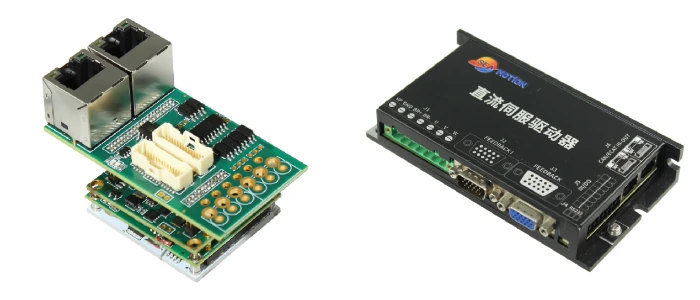
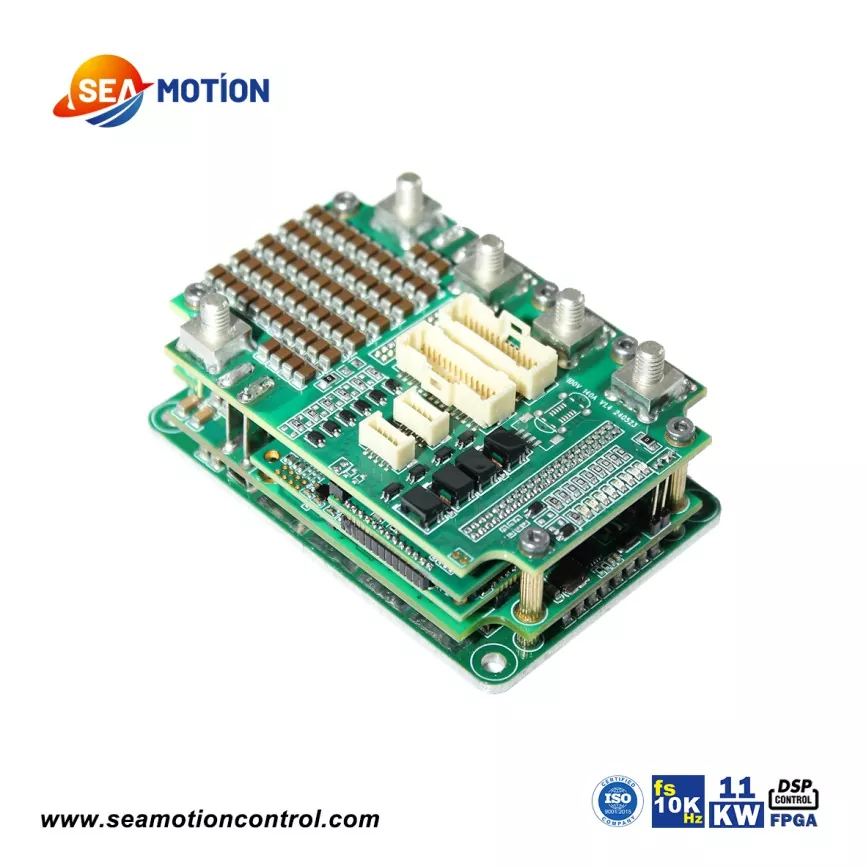
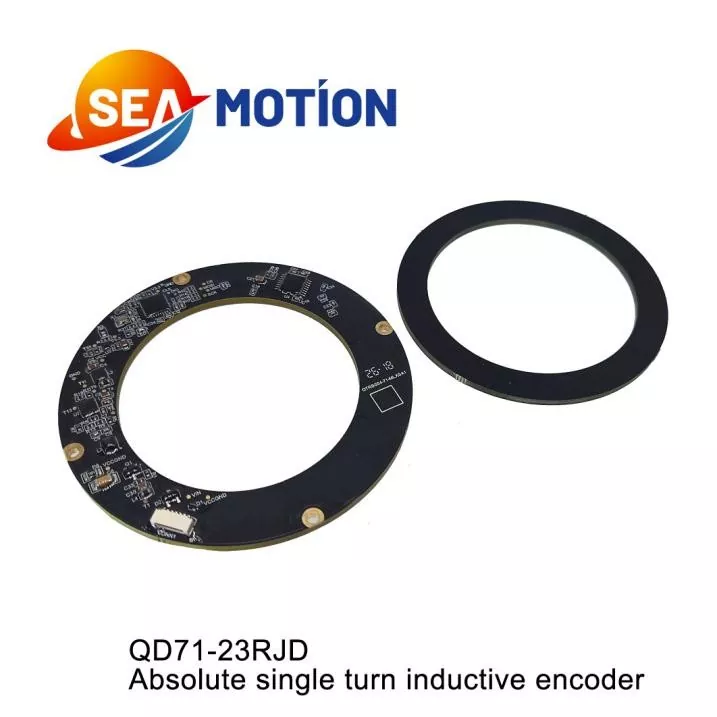
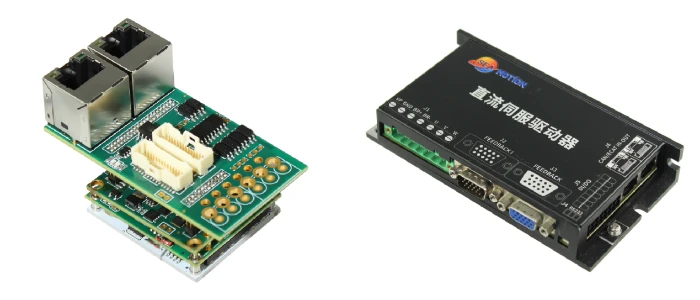
Left: SEA M series, a modular multi-board stack designed to sit inside the machine. Right: SEA P series, an enclosed metal-housing unit with dual feedback and multi-protocol fieldbus.
General industrial automation is the least forgiving market for a servo drive, and not because the specifications are hard.
Customers in logistics conveying, packaging machinery, woodworking and textile equipment, special-purpose CNC machines and mobile robots ask for very little on paper: a low-voltage bus under 100 V, anywhere from a few amps to tens of amps of continuous current, stable position and velocity control, and enough tolerance for the dust and vibration of a shop floor. What they are extremely sensitive to is price and delivery.
SEA M and SEA P were taken back to the drawing board for that market, and the work landed in three places.
Structure, redesigned to remove cost general industry never uses. Power device layout, heat-spreading path, busbar routing and connector selection each map directly onto cost and reliability. SEA MOTION reworked the mechanical and electrical architecture of both series, trading margin that had been reserved for higher-performance duty for a form factor that general industry actually needs.
Control algorithms retuned for repeatability. The technical resources of general industrial customers vary widely. A drive that needs repeated on-site tuning before it will run steadily carries a hidden cost far larger than its purchase price. SEA MOTION modified the control algorithms for better unit-to-unit consistency when drives go into a batch of machines — the part general industrial customers care about most and can read least from a datasheet.
A domestic bill of materials. This is the most direct route to lower cost and the hardest to walk. Swapping a single component is easy.
Swapping an entire BOM is not. It means re-running selection validation, re-matching drive parameters, and repeating thermal and EMC qualification. SEA MOTION completed that substitution round, and took back supply-chain lead time and uncertainty along with the cost reduction.
For the customer, the three together produce one outcome: precision motion control stops being something only high-end equipment can afford.
Cobot arms, quadruped and bipedal robots, exoskeletons and powered wearables, precision rotary stages — these applications share one constraint: there is nowhere to put a control cabinet. Space inside a joint housing is measured in millimetres, cable length feeds directly into reliability, and any externally mounted drive pays for itself in weight, volume and failure rate.
SEA MOTION's answer is to make the drive a hollow ring board. The bore slips over the motor shaft end and four screws fix it to the rear of the joint, so the drive grows into the motor instead of hanging off it.
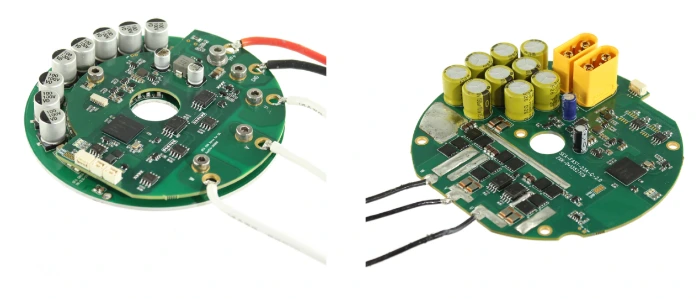
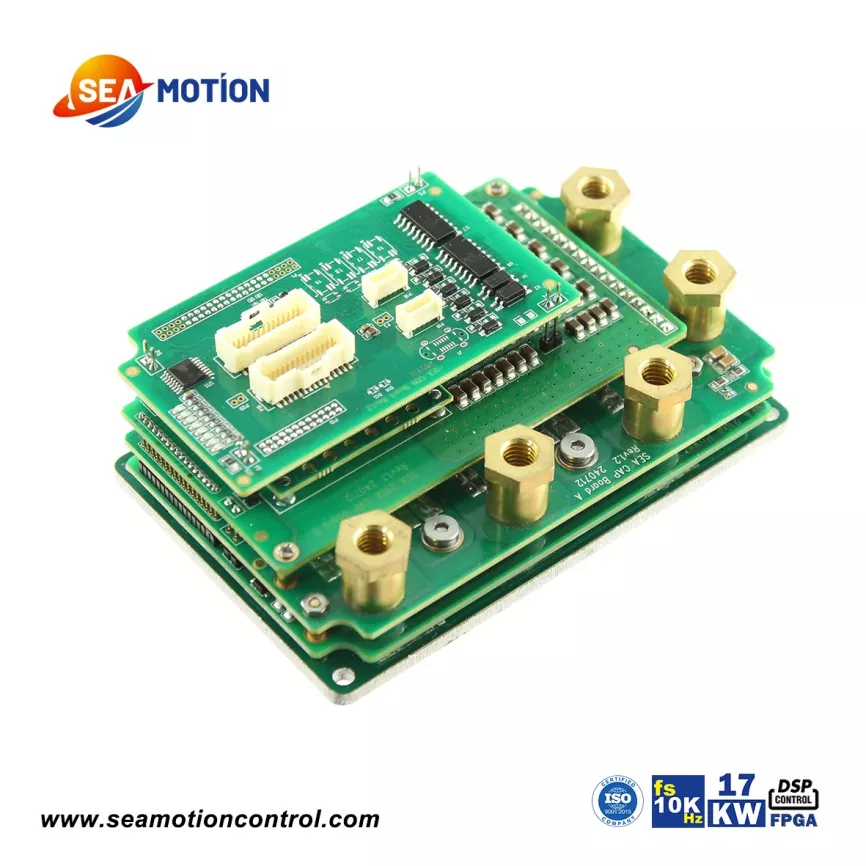
Left: SEA C105, a Ø104 mm ring board with stacked power and control boards. Right: SEA C116, a Ø116 mm single-board design with components on both sides.
|
Item |
SEA C105 |
SEA C116 |
|
Outer diameter / bore |
Ø104 mm / Ø12.8 mm |
Ø116 mm / Ø15 mm |
|
Board thickness |
1.6 mm |
3.0 mm |
|
Construction |
Power board and control board stacked; aluminium-backed plus FR-4 |
Single double-sided FR-4 board |
|
Mounting |
4 × Ø2.2 mm on a Ø100 mm bolt circle |
4 × Ø3.0 mm through holes |
|
Current (rated / peak) |
30 A / 100 A |
23 A / 110 A |
|
Control core |
Dual-core DSP + MCU |
Field-oriented control with MTPA and field weakening |
|
Control modes |
Position / velocity / torque |
Position / velocity / torque / MIT hybrid |
|
Protection |
Overvoltage, overcurrent, overtemperature |
Overcurrent, overvoltage, undervoltage, overtemperature, short circuit, encoder and CAN communication faults |
Source: SEA C105 and SEA C116 product manuals, SEA MOTION, 2026.
Both boards stay under 116 mm across while delivering 100 A and 110 A peak. For scale: the SEA M enclosed industrial unit tops out at 100 A, while SEA C116 reaches 110 A peak from a Ø116 mm board on a 72 V bus. That is a real step in power density, not a datasheet exercise.
The engineering trade-offs behind the two models also differ. SEA C105 stacks a power board and a control board, uses the aluminium substrate for heat spreading, keeps thickness at 1.6 mm and runs a DSP plus MCU dual-core architecture — a division of labour that puts thermal management first. SEA C116 compresses the entire circuit onto one 3.0 mm double-sided board, buying a shorter power loop and lower parasitic parameters with higher integration.
The current ratios point the same way: C105 at 30 A rated and 100 A peak suits duty cycles with a high sustained-load share, while C116 at 23 A rated and 110 A peak has a wider peak-to-rated ratio and leans toward transient acceleration and shock loads — the typical duty of a humanoid or quadruped joint.
Two features on SEA C116 are easy to skim past and immediately legible to anyone who builds joint modules.
Dual BISS-C encoder inputs. C116 provides two independent BISS-C channels. Channel A takes the motor-shaft encoder; channel B takes the encoder on the reducer output shaft. The drive therefore sees motor position and joint output position at the same time, closing the loop across the backlash, compliance and transmission error of a harmonic reducer.
For a cobot arm with an end-effector accuracy target, this is the difference between hitting the number and not. The two channels can be routed separately through CN1 and CN2, or combined into a single 10-pin FPC connector, which leaves room for cable routing inside the joint.
MIT hybrid control mode. Beyond the conventional position, velocity and torque modes, C116 supports MIT mode — the de facto standard interface for impedance control in collaborative robotics, and the common language of both open-source and commercial joint-module ecosystems. Whether a drive supports MIT largely decides whether mainstream joint designs can adopt it directly.
Add field-oriented control with MTPA and field weakening, precision phase-current sampling, and a protection chain covering overcurrent, overvoltage, undervoltage, overtemperature, short circuit, encoder faults and CAN communication faults.
SEA C116's position is clear: it is not a shrunken industrial servo, but a drive laid out from the joint outward.
The interesting number in this launch is not 110 A. It is the interval.
Defining, designing, validating and releasing four models across three series inside a month does not come from running four projects in parallel. It comes from a hardware platform and a software core that can be trimmed per application.
The power-conversion topology, phase-current sampling scheme, current and position loop algorithms, CAN and RS485 protocol stacks and the PC configuration tool are shared across all four. The envelope, thermal design, connector set and feedback type are trimmed per customer scenario.
That capability breaks down into four layers:
Power stage — from a 100 V / 100 A enclosed industrial unit to a 72 V / 110 A ring board 116 mm across, a step change in power density.
Control algorithms — from stability-first tuning for general industry to MTPA, field weakening and MIT hybrid control for joints.
Feedback ecosystem — Jingang absolute encoders and dual BISS-C running in parallel, covering two different encoder families.
Vertical integration — drive hardware, communication firmware, PC configuration software, mechanical parts and thermal design, all developed in-house.
Plenty of companies in the servo drive industry do one of those layers well. Fewer do all four, and fewer still ship two fundamentally different product forms from the same platform within a month.