
As robotic hands become increasingly capable of performing delicate manipulation and human-like movements, selecting the right joint actuator is essential for achieving precise motion and reliable force feedback. SEA MOTION provides advanced motion control solutions, including the Dexterous Hand Joint Module, designed to meet the demanding requirements of compact robotic hands, multi-finger grippers, and intelligent robotic systems. Its TS20 series integrates a motor, reducer, dual encoders, and an internal servo drive into an exceptionally compact structure, helping engineers simplify system integration while improving motion accuracy and control flexibility.
A dexterous hand joint module is a compact integrated actuator that enables robotic fingers and mechanical joints to perform accurate, coordinated movements. This article explores its operating principles, essential technical specifications, performance advantages, application scenarios, and selection considerations. Using SEA MOTION's TS20 series as an example, it explains how a 20 mm diameter integrated joint module combines high-resolution feedback, low backlash, impedance control, and high-speed RS485 communication to support advanced robotic manipulation.
1. What Is a Dexterous Hand Joint Module?
2. How Does a Dexterous Hand Joint Module Work?
3. Key Technical Specifications and Performance Comparison
4. What Are the Core Design Advantages?
5. Why Is Impedance Control Important for Robotic Hands?
6. Major Applications in Robotics and Automation
7. How to Choose the Right Dexterous Hand Joint Module
8. Installation and Maintenance Considerations
A Dexterous Hand Joint Module is an integrated motion control component specifically designed to drive the joints of robotic fingers and other compact robotic mechanisms. Unlike conventional motors that require separate gearboxes, encoders, and external drive electronics, an integrated joint module combines these essential components into one compact assembly.
This integration is particularly important in robotic hands because the available installation space is extremely limited. Each finger may contain multiple independently controlled joints, and the overall system must balance compact dimensions, low weight, sufficient torque, and accurate feedback.
The SEA MOTION TS20 series addresses these requirements through several integrated technologies:
By integrating these components, the module simplifies mechanical and electrical system design while providing the feedback capabilities required for precise robotic manipulation.
The operating principle of a dexterous hand joint module involves coordinated motor operation, mechanical transmission, encoder feedback, and closed-loop control.
When the host controller sends a motion command, the integrated drive processes the target position, velocity, stiffness, damping, and feedforward torque. The motor then generates rotational movement, which passes through the precision reducer to drive the connected robotic joint.
Meanwhile, the encoder system continuously measures the motion state. This feedback allows the controller to compare actual performance with the commanded movement and adjust the motor output accordingly.
The TS20 uses a dual-encoder architecture, with feedback available from opposite ends of the gear train. This arrangement helps the control system observe output-side movement rather than relying exclusively on motor-side measurements.
Its control process can be summarized as follows:
This integrated architecture helps robotic hands achieve coordinated movement and controlled interaction with objects of different sizes, shapes, and mechanical properties.
Technical specifications directly influence whether a joint actuator can meet the mechanical and control requirements of a robotic hand. The SEA MOTION TS20 is available in two configurations: TS20-50 and TS20-100. Both models share the same mechanical envelope but offer different torque and speed characteristics.
| Technical Parameter | TS20-50 | TS20-100 |
|---|---|---|
| Gear Ratio | 50:1 | 100:1 |
| Rated Torque | 0.7 N·m | 1.5 N·m |
| Peak Torque | 2 N·m | 4 N·m |
| Peak Torque Duration | 300 ms | 300 ms |
| Maximum No-Load Speed | 31.4 rad/s | 15.7 rad/s |
| Backlash | Below 20 arc-seconds | Below 20 arc-seconds |
| Encoder | Dual 24-bit | Dual 24-bit |
| Dimensions | Ø20 × 35 mm | Ø20 × 35 mm |
| Hollow Bore | Ø1.7 mm | Ø1.7 mm |
| Weight | 35 g | 35 g |
| Rated Voltage | 24 VDC | 24 VDC |
| Communication | RS485 | RS485 |
| Back-drivable | Yes | Yes |
In addition to mechanical performance, the TS20 incorporates an advanced communication and control interface:
These specifications make the module suitable for applications that require compact mechanical integration, high-resolution feedback, and responsive motion control.
Choosing an appropriate dexterous hand joint module involves more than comparing rated torque and motor speed. Mechanical dimensions, feedback architecture, control flexibility, and integration complexity also influence overall robotic system performance.
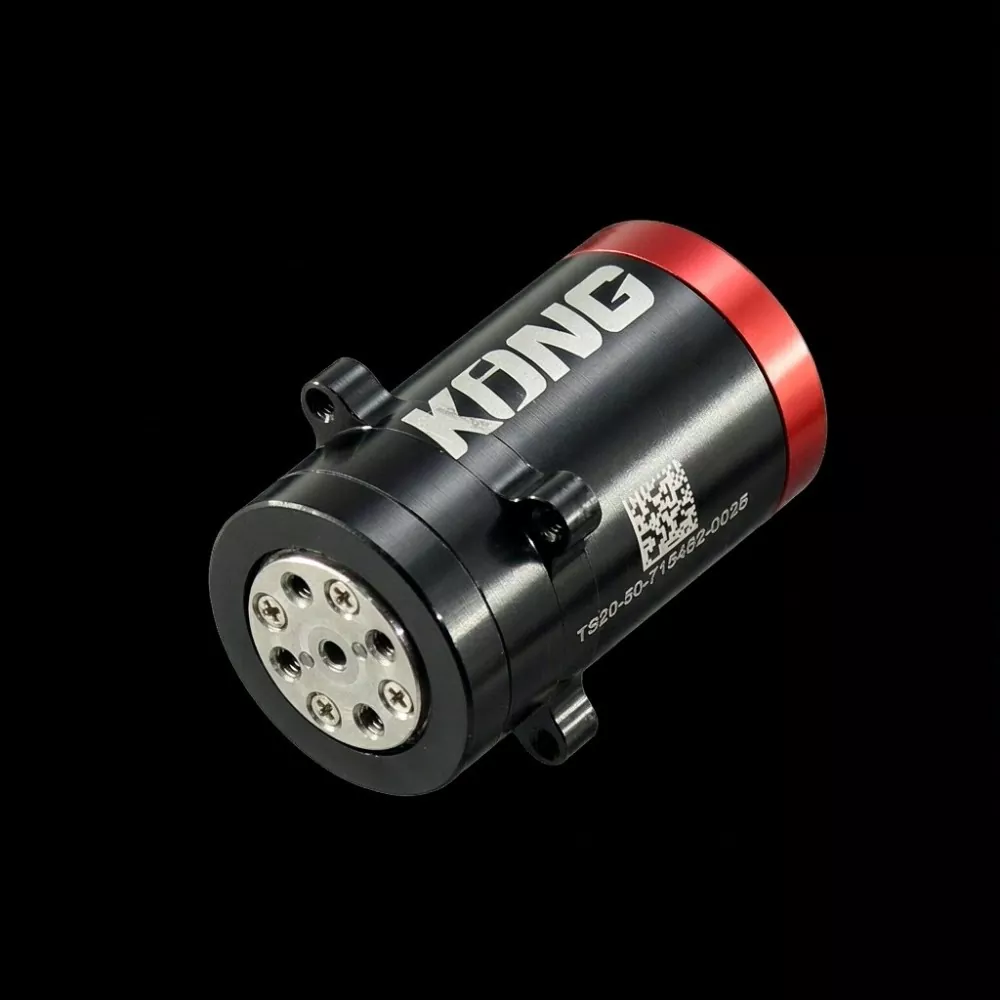
The TS20 features a cylindrical housing measuring only Ø20 mm in diameter and 35 mm in length, with a total weight of 35 g. This compact form factor allows engineers to install actuators within limited finger-joint spaces without significantly increasing the overall mass of the robotic hand.
Two independent 24-bit encoders provide detailed motion feedback. Combined with output-side measurement and backlash below 20 arc-seconds, this architecture supports accurate position monitoring and improved control of small joint movements.
The 50:1 and 100:1 configurations share the same housing and Ø24 mm mounting flange. Engineers can therefore evaluate different torque and speed requirements without redesigning the main mechanical mounting structure.
The built-in field-oriented control drive eliminates the need for a separate external motor driver. The module operates with a 24 VDC supply and an RS485 communication connection, reducing the number of components required for system integration.
Back-drivability allows the output shaft to respond to external forces instead of behaving like a rigid, locked transmission. This characteristic is particularly valuable when a robotic finger makes unexpected contact with an object or needs to adjust its gripping force.
The Ø1.7 mm hollow bore creates a dedicated routing path through the joint axis. It can accommodate a tendon or signal lead, helping engineers organize internal wiring and mechanical transmission elements within compact robotic assemblies.
Robotic hands must often perform tasks involving physical interaction, such as holding fragile objects, manipulating tools, and maintaining stable contact with irregular surfaces. Position control alone may not provide sufficient flexibility for these operations.
Impedance control enables a robotic joint to regulate its response to position errors and external forces. The TS20 supports an integrated impedance control model expressed as:
τ = Kp (θdes − θ) + Kd (ωdes − ω) + τdes
Where:
By adjusting stiffness and damping, engineers can configure different mechanical response characteristics for different tasks.
For example, a robotic finger can use a relatively compliant response when initially contacting an object and increase stiffness when greater positional stability is required. Setting Kp to zero enables torque-source behavior, which can be useful for force-controlled finger applications.
This flexibility makes impedance control an important capability for advanced robotic hands that need to balance movement accuracy with physical interaction.
The combination of compact dimensions, integrated electronics, and flexible control makes a dexterous hand joint module useful across several precision motion applications.
Each robotic finger may require multiple independently controlled joints. Compact actuators help designers distribute the required drive units throughout the finger structure while maintaining an appropriate weight and mechanical envelope.
Small humanoid robots require lightweight and responsive joints to support natural movement and object manipulation. Integrated joint modules can simplify the design of hands and other compact articulated mechanisms.
Industrial and research grippers often need to handle objects with different dimensions and surface properties. Adjustable stiffness, torque control, and encoder feedback help support more adaptable gripping strategies.
Compact robotic arms used in laboratories, educational environments, and research facilities benefit from integrated actuators that reduce wiring complexity and simplify mechanical assembly.
In specialized positioning systems and aerospace micro-servo assemblies, limited installation space and strict mass requirements make compact motion control components particularly valuable. Actual suitability depends on the application's environmental, safety, and performance validation requirements.
Selecting a suitable joint module requires a comprehensive evaluation of the mechanical structure, motion requirements, control architecture, and operating environment.
Consider the following factors before making a purchasing decision:
The transmission ratio is one of the most important considerations when choosing a TS20 configuration.
Both configurations share the same mechanical dimensions and mounting interface, allowing engineers to compare their performance during prototyping without changing the basic mechanical design.
Correct installation is essential for maintaining the mechanical accuracy and operational reliability of a precision joint module.
When installing the SEA MOTION TS20, engineers should pay particular attention to the following details:
The TS20 also incorporates protection functions covering over-current, over-voltage, under-voltage, transient over-voltage, FET over-temperature, motor over-temperature, and encoder errors. Engineers should review fault-handling procedures and operating limits during system commissioning.
For transportation, individual units are packaged in anti-static bags, cushioned with protective foam, and placed in separate boxes to help protect the output flange and electrical connections.
A: Its main function is to provide controlled rotational movement and feedback for robotic finger joints. It enables robotic hands to perform precise positioning, coordinated finger movement, and adjustable force interaction with objects.
A: An integrated joint module combines the motor, reducer, encoder system, and drive electronics into one assembly. This reduces external wiring and component requirements while providing a more compact solution for space-constrained robotic mechanisms.
A: The primary difference is the gear ratio. TS20-50 provides 0.7 N·m rated torque and a maximum no-load speed of 31.4 rad/s, while TS20-100 provides 1.5 N·m rated torque and a maximum no-load speed of 15.7 rad/s. Both models have the same dimensions and weight.
A: No. The TS20 integrates its field-oriented control drive into the joint module. It requires a 24 VDC power supply and an RS485 communication connection for operation.
A: The TS20 supports RS485 communication at 7.5 Mbps and uses the MIT impedance mode protocol, version 3.4. Its command and response frames are 14 bytes long and incorporate CRC16-CCITT verification.
A: Yes. Its compact Ø20 mm × 35 mm structure, 35 g weight, and configurable device IDs make it suitable for integration into multi-finger robotic hands and compact gripper systems.
A: Yes. Cable leads can be terminated according to specified lengths, and connectors can be added at the end cap for volume production requirements.
A: The listed product information specifies a minimum order quantity of 5 pieces and a lead time of approximately 4 weeks. Buyers should confirm the latest production schedule and delivery conditions when requesting a quotation.
A: Pricing depends on the selected gear ratio, cable termination requirements, and order quantity. Buyers can provide their preferred configuration and estimated annual demand to SEA MOTION for a quotation.
The performance of a modern robotic hand depends heavily on the quality of its joint actuation and feedback systems. A well-designed Dexterous Hand Joint Module must combine compact dimensions, sufficient torque, accurate sensing, responsive communication, and flexible control to meet increasingly demanding robotic applications.
The SEA MOTION TS20 series brings these capabilities together through its integrated motor, precision reducer, dual 24-bit encoders, and built-in FOC drive. With two transmission ratio options, backlash below 20 arc-seconds, back-drivable output, and high-speed RS485 communication, it provides engineers with a practical motion control solution for dexterous hands, multi-finger grippers, and other compact robotic mechanisms.
As robotics technology continues to advance, selecting an appropriate joint module will remain an important step in improving manipulation precision, mechanical integration, and overall system performance.
Looking for a reliable dexterous hand joint module for your next robotic project? SEA MOTION offers integrated motion control solutions and configurable TS20 joint modules to support different engineering and application requirements. Whether you are developing a humanoid robotic hand, a precision gripper, or a compact robotic arm, our team can help you evaluate gear ratios, torque requirements, mounting dimensions, and communication compatibility. Explore our Dexterous Hand Joint Module product details today and contact us to discuss your technical requirements, request a sample, or obtain a customized quotation.